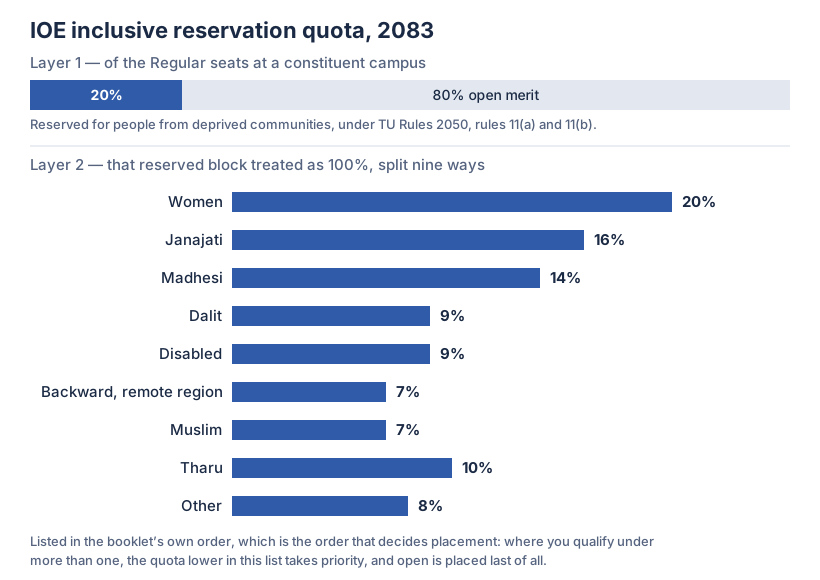

Can I use a reservation quota at more than one IOE campus?

No. An applicant admitted under a reserved quota at one constituent campus cannot later be admitted under a reserved quota at another, reserved names are published only for the first three lists, and the reservation facility may be used at one level of study only.
A reservation at IOE is a single use, and three separate limits enforce that. An applicant already admitted under a reserved quota at one constituent campus cannot later be admitted under a reserved quota at another, so the reservation does not travel with you if a better list appears somewhere else. For constituent campuses, applicants seeking any reserved quota have their names published on merit only for the first-phase admission programme, which means the first, second and third lists; once allocation moves to the per-campus lists that run after the third, the reservation is no longer being published against your name. And the reservation facility may be used at only one level of study, so it is not something you can draw on again for a later degree. Passing the entrance examination is still required in every case.
One campus only
An applicant who has been admitted under a reserved quota at one constituent campus cannot later be admitted under a reserved quota at another campus. If you take a reserved seat and a better list then appears elsewhere, you cannot carry the reservation across to it. You could still move on open merit, at the open cut-off, which is the point of the rule.
First phase only
For TU constituent campuses, applicants wanting admission under any reserved quota have their names published on merit only for the first-phase admission programme, meaning the first, second and third lists. The reservation does not extend into the per-campus lists that run after the third, so a candidate relying on it has three chances rather than an open-ended series.
One level of study only
The booklet states that the reservation facility may be used at only one level. Someone who entered a bachelor’s programme under a reserved quota is treated as having used it, which matters when the same person later applies for a master’s under the same scheme.
What follows for how you rank your choices
If a reserved seat is the route you are relying on, the campus you actually want has to be high in your priority order from the start. Waiting to see how the first list falls and then hoping to use the reservation later does not work in either direction: it will not carry you into a fourth-list seat, and it will not move with you once you have used it.
Applying on the full-fee side cancels it outright
There is a fourth limit and it is the one that surprises people, because it is not about using the reservation twice but about applying for it at all. The booklet provides that where a full-fee applicant applies under this reservation quota, that reservation application is automatically cancelled. The quota and the full-fee route are alternatives rather than a hedge, so an applicant who files for both does not end up with two chances. They end up with the full-fee one.
What the reservation does not get you
A cheaper degree. The booklet states that a student admitted under this reservation quota pays the whole of the same fee a regular student pays, so the quota changes where you are allocated and not what you are billed. It is worth saying because the two are routinely assumed to travel together, and a family planning around a reserved seat should plan around the ordinary fee.
And what a false claim costs
The admission itself, and more. Where a person is proved to have obtained the reservation facility by submitting false particulars, the booklet requires the admission to be cancelled and action to be taken under the law. That is a heavier consequence than a rejected application, and it applies after enrolment rather than only at the counter.
It does not replace the entrance
Reserved-category admission still requires passing the entrance and appearing on the central merit list, and every reserved list is published in entrance merit order. Reservation affects allocation, not eligibility.
Section 5.3 of the BE/B.Arch Booklet 2083, page 12, for the one-campus and first-phase limits; the one-level limit and the pass requirement are at 6.3(c) and 6.3(d), page 15; the full-fee cancellation, the false-particulars clause and the fee rule are at 6.3(ch), 6.3(chh) and 6.3(j), page 16.
Sources
- IOE B.E./B.Arch Booklet 2083published 7 August 2026 · read 18 August 2026
Last reviewed by Ram Raj Thapa, Admissions Officer, Imperial College of Engineering. Every figure on this page is cited to the document it came from.