
Can I hold two IOE seats at once?

No. You may hold only one seat at a time, and an earlier admission has to be formally cancelled before a new one can be recorded. Cancelling before classes start costs 10% of the fee you paid or Rs 15,000, whichever is less, and the deduction rises from there.
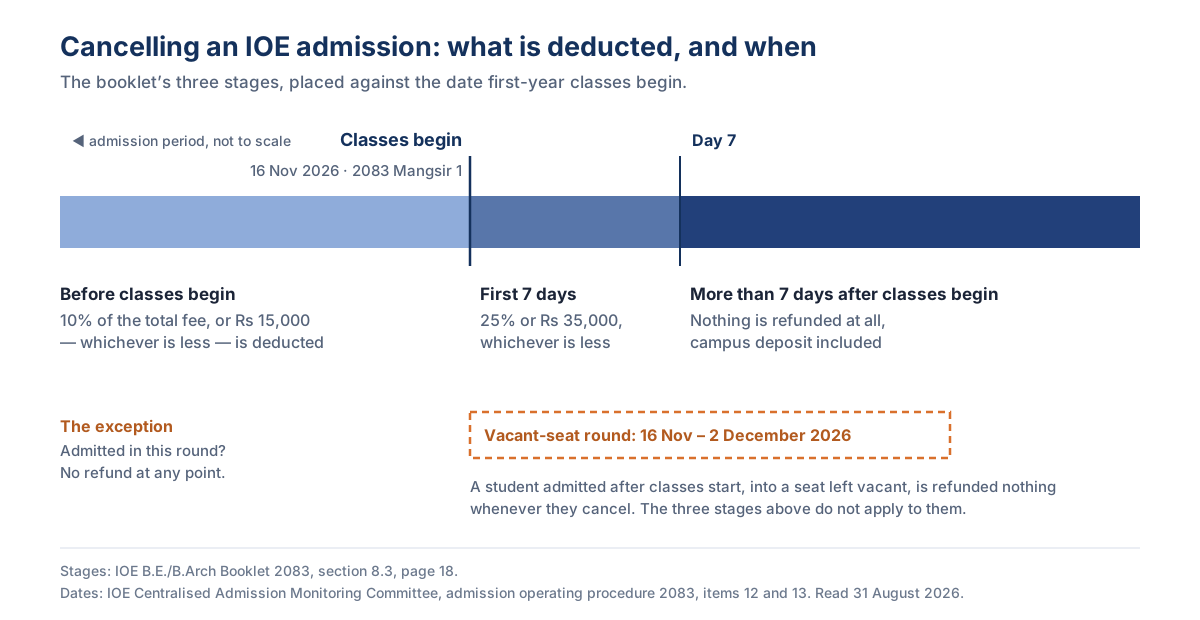
IOE’s procedure is explicit. Once you are admitted at one campus or college, and your name then appears at another, you can only be admitted at the second after the first admission has been cancelled. The cancellation is not free, and the price rises as term approaches: 10% of the total fee paid or Rs 15,000 before classes begin, whichever is less; 25% or Rs 35,000 within seven days of them starting; and nothing refunded at all after that, campus deposit included. The same clauses bind TU-affiliated private colleges, not only constituent campuses.
How to think about a safe seat
- It is genuinely worth taking if you would rather study there than not study this year.
- It is not free insurance. You pay to enter and you pay to leave.
- The deduction is a percentage of what you paid, so a safe seat at a full-fee price is an expensive hedge.
- Before paying for a seat you are unsure about, ask what cancellation costs and how long the refund takes, in writing.
How is a cancellation actually done?
Through the same central system that recorded the admission. The procedure requires every campus and college to carry out both admission cancellation and programme change from its own login on the central admission portal, which means a cancellation your college has agreed to but not entered is not a cancellation. Ask for the portal confirmation, not for a verbal assurance, before you go and take the other seat.
What happens if you simply do not turn up?
Your admission is cancelled and your seat is given away. The booklet provides that a student who is absent from class for seven days from the date classes begin, without notice and a proper reason, has their admission cancelled, and the place is republished in merit order and filled by someone else. Abandoning a seat quietly is therefore not a way of keeping options open; it is a way of losing the seat and the money.
Why the calendar forces the decision on you
The one-seat rule would cost nothing if you could wait and see. The published schedule makes sure you cannot. In the 2083/84 cycle the first list’s admission window ran from 24 to 27 August 2026, and the second list was not published until 30 August. So a candidate holding a first-list place at a lower choice had to pay for it, or let it go, three days before learning whether the second list reached the college they actually wanted. The second and third rounds repeat the shape: admission from the second list closed on 2 September and the third list appeared on 6 September. Every gap in the calendar is a decision taken without the next piece of information, and the cancellation ladder is the price of guessing wrong.
The late window, and the trap in it
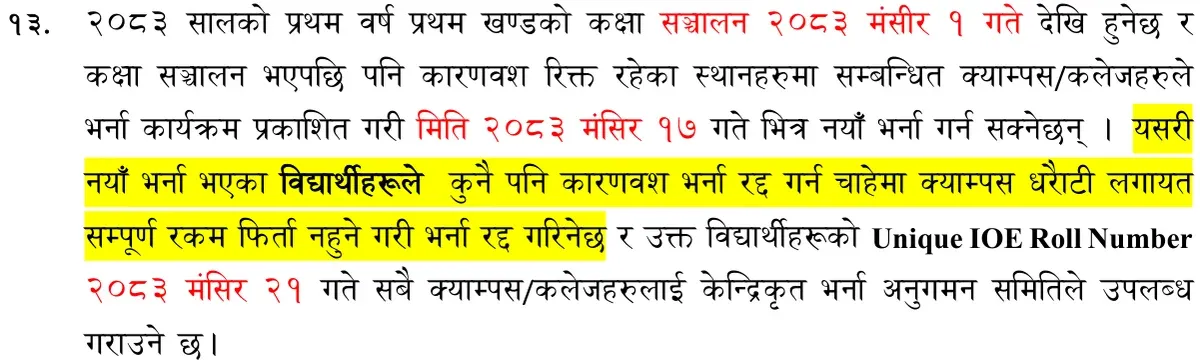
Seats that fall vacant can still be filled after classes begin, up to 2 December 2026. If you take a seat in that window and later cancel it, the procedure refunds nothing at all, campus deposit included, and that is harsher than the ordinary ladder above. Students admitted then receive their roll numbers on 6 December.
One seat, and then one programme
The rule does not stop binding once you have chosen. From the day your Unique IOE Roll Number is issued, the programme recorded against it is fixed at that campus too, and the only movement left inside it is from the Full Fee category to the Regular category. So the seat you hold in November is not merely a college. It is a college and a programme and a fee category, and two of those three stop being negotiable on the same day.
Cancellation ladder and the seven-day absence rule from the BE/B.Arch Booklet 2083, section 8, pages 18 and 19; section 8.6 extends sections 7.1, 7.4 and all of section 8 to TU-affiliated colleges. The one-seat rule and the login-portal requirement are items 8 and 10 of the Admission Guidelines 2083, and the no-refund late window is item 13.
Sources
- IOE Admission Guidelines 2083 (Centralized Admission Monitoring Committee)published 12 August 2026 · read 18 August 2026
- IOE B.E./B.Arch Booklet 2083published 7 August 2026 · read 18 August 2026
Last reviewed by Ram Raj Thapa, Admissions Officer, Imperial College of Engineering. Every figure on this page is cited to the document it came from.