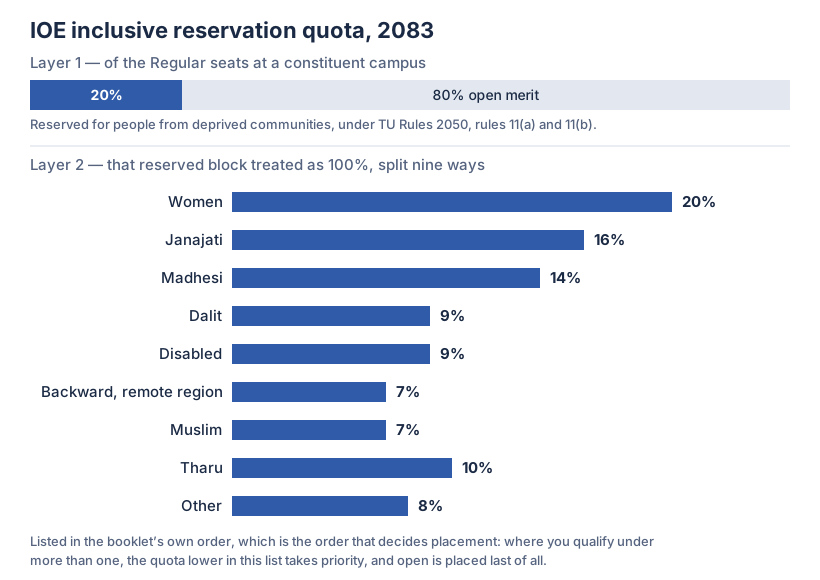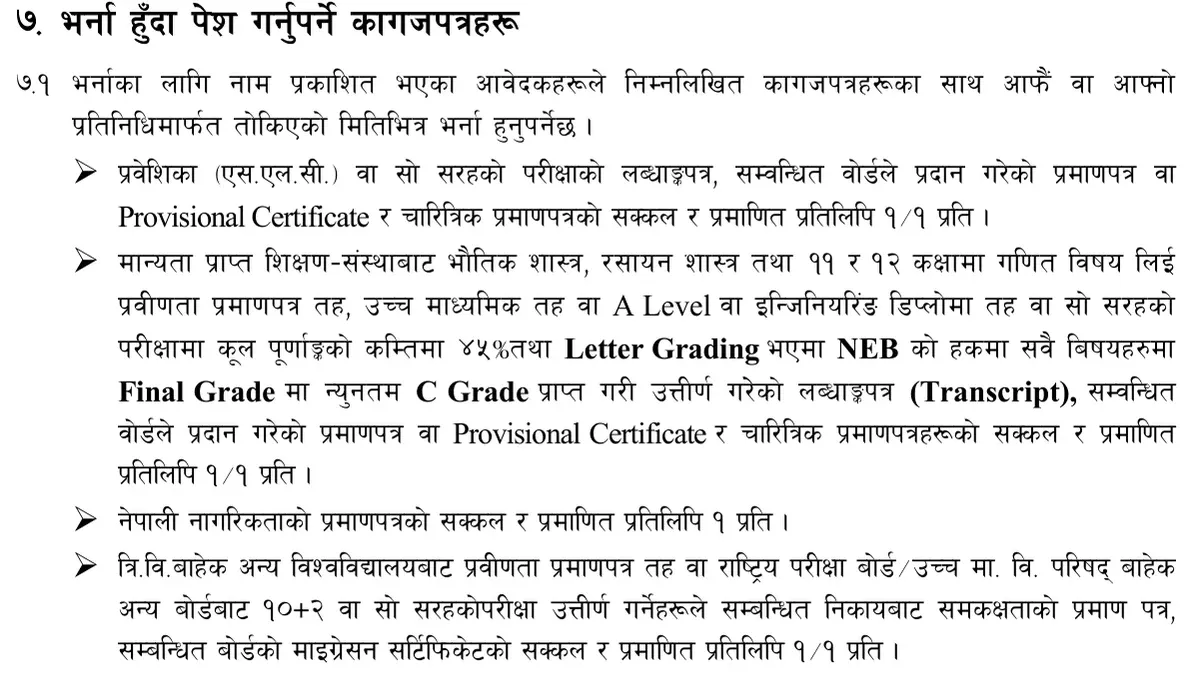

When are reservation quota documents due at IOE?

Within five days of the date the entrance result is published, at the place IOE designates. The booklet states that after that date no action is taken on a late candidate’s documents at all, so missing it forfeits the quota rather than delaying it.
Anyone who wants a seat under one of IOE’s reserved quotas has to submit the required documents within five days of the date the entrance result is published, at the place the Institute of Engineering designates. The booklet states the consequence plainly: after that date, no action is taken on the documents of candidates who submit late. It is the shortest and least advertised deadline in the whole admission process, and missing it forfeits the quota rather than delaying it. The clock starts at the result, not at a merit list and not at a campus list, so it runs during the week everybody else is still working out what their rank means. A second, related cut-off sits alongside it: the complete document set has to be in before the first-phase lists are published, within the date applications were called for.
What exactly is the rule?
Candidates seeking admission under any of the quotas in sections 6.1 to 6.5 must submit all the required documents to the place designated by IOE within five days of the date the entrance result is published. The booklet then closes the door in one sentence: after that date, no action is taken on the documents of candidates who submit late. There is no discretion clause attached to it and no appeal named.
Why does it catch so many people?
- Five days from the result, not five days from the merit list or from a campus list.
- It runs while everybody else is still working out what their rank means, so nothing around you signals that a deadline is passing.
- The documents proving a reserved category are usually the slowest ones to obtain, because they come from a district office, a national commission or a local government rather than from a school.
- The campus will not attest your copies. The booklet puts the responsibility for getting them attested by an authorised person on the applicant, which is another queue inside the five days.
There are two deadlines, and the earlier one binds
The five-day rule in the preamble to section 6 is the one most people meet first. The inclusive quota and the government-sponsored quota each carry a second statement of the same duty, requiring the complete set to be submitted before the first-phase admission lists are published, within the date on which applications were called. Where the two differ, work to whichever falls first, because neither section provides a way of curing a late submission.
When did the five days actually fall in 2083?
The 2083 entrance result went up on 4 August 2026, so the five-day window ran to 9 August 2026 and it is now closed. That is worth stating as a date rather than as a rule, because the gap it opens is the whole point: the first merit list was not published until 23 August, a fortnight after the quota documents were already due. A candidate who waited for a list before assembling paperwork had missed the deadline before there was anything to look at. In a later cycle the rule is the durable part and the dates move with that year’s result notice, so read the five days off the result, never off a list.
Which office issues which certificate?
Each reserved category is proved by a different body, and this is where the five days actually go. The booklet names them one by one: an applicant with a disability produces a certificate from the National Federation of the Disabled or the relevant government body; an Adivasi or Janajati applicant from the Adivasi/Janajati Uplift National Foundation or the relevant District Administration Office; a Dalit applicant from the National Dalit Commission or the relevant District Administration Office; an applicant from a backward remote area from their own rural municipality or municipality; and Madhesi, Tharu and Muslim applicants from the relevant District Administration Office. A deprived applicant additionally needs a recommendation from the local level, with the basis and the reason stated.
What to do about it
If you intend to apply under any reserved category, assemble the documents before you sit the examination rather than after the result. Confirm the exact list and the submission point with IOE in advance, and count the attestation and the travel inside the five days rather than outside them.
From the preamble to section 6 of the BE/B.Arch Booklet 2083, pages 12 and 13. The documents required for each route are listed under sections 6.1 to 6.5, and the issuing bodies at 6.3(5), page 16; the second cut-off is at 6.3(j), page 16, and in the closing paragraph of 6.4, page 17. The attestation rule is the standing note on page 25. The 2083 result date is from the Office of the Dean’s result notice of 2083/04/19; dates converted from Bikram Sambat and belonging to that cycle only.
Sources
- IOE B.E./B.Arch Booklet 2083published 7 August 2026 · read 18 August 2026
Last reviewed by Ram Raj Thapa, Admissions Officer, Imperial College of Engineering. Every figure on this page is cited to the document it came from.