
Which documents do I need at IOE admission?
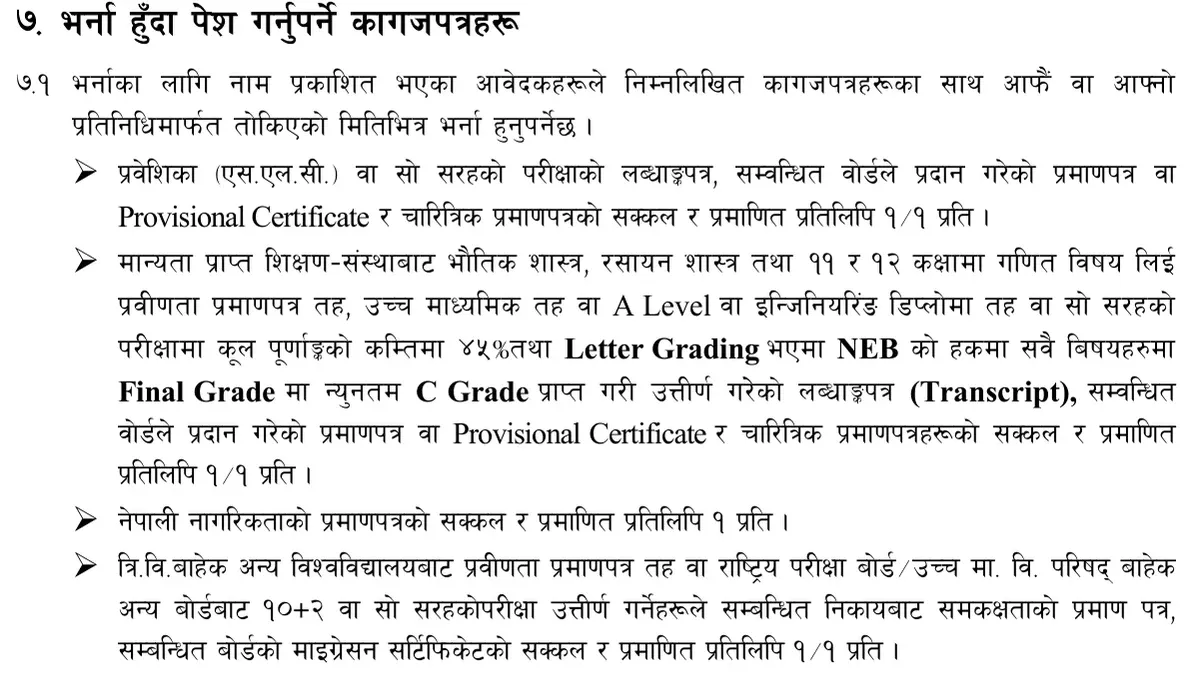
Originals and one attested copy each of your SEE and +2 transcripts, board certificates, character certificates and Nepali citizenship certificate. Equivalence and migration certificates apply only if you came from outside Tribhuvan University or the NEB. You may send a representative in your place.
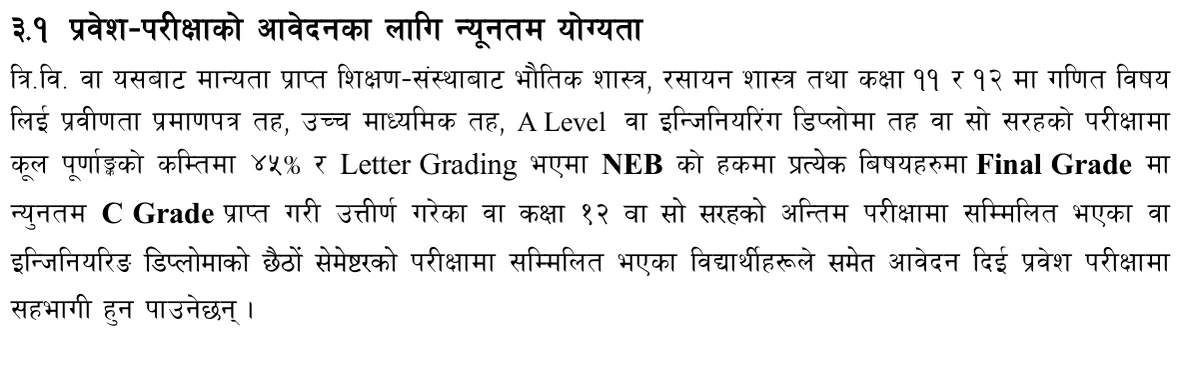
The booklet sets one checklist and it applies at constituent campuses and at TU-affiliated private colleges alike. Applicants whose names are published in a list must complete admission by the stated date, in person or through a representative, bringing the original and one attested copy of each document: the SEE marksheet with its board certificate or Provisional Certificate and character certificate; the +2, PCL, A Level or engineering diploma transcript showing at least 45% of total marks or, under letter grading, a minimum C grade in every subject in the Final Grade, again with the board certificate and character certificate; and the Nepali citizenship certificate.
What does everyone bring?
- SEE or equivalent marksheet, the board-issued certificate or Provisional Certificate, and the character certificate.
- +2, PCL, A Level or engineering diploma transcript showing at least 45% or, under letter grading, minimum C Grade in all subjects in the Final Grade, plus the board certificate or Provisional Certificate and the character certificate.
- Nepali citizenship certificate.
Which two documents do most students chase unnecessarily?
Equivalence and migration certificates. They are required only if you came from a university other than Tribhuvan University, or from a board other than the National Examination Board or the Higher Secondary Education Board. If you did NEB +2 and you are entering TU, they do not apply to you. This is the single most common wasted errand in the whole process, so ask your campus before you go looking.
Can someone else complete the admission for you?
For the admission itself, yes. The booklet allows a named applicant to be admitted in person or through a representative, which is the provision that saves a candidate who is out of the country, unwell or sitting another examination on the day. Two later steps are not covered by it: the campus identity card and library card require the student to attend in person on the day the campus notifies, carrying two passport-size and two auto-size photographs. Plan for one trip you can delegate and one you cannot.
What if the originals do not match?
The admission is refused, or reversed. The booklet provides that where verification of the original certificates shows different marks or other differing details, or where a name was published in error, the applicant is not admitted, and an admission already completed by mistake is cancelled. Bringing an attested copy without the original does not defer that check, it only postpones it.
Foreign applicants
An attested copy of the passport. Indian applicants submit an identity certificate with photograph issued by the Indian Embassy in Nepal. Students from countries outside SAARC may be admitted with the approval of the Entrance Examination Board.
Reserved-category documents run on a different clock
Everything above is due at admission, which is the window of the list that names you. The documents proving a reserved category are not. Those are due at the place IOE designates within five days of the date the entrance result is published, weeks before any list appears, and the booklet states that no action is taken on them after that date. So a candidate applying under a quota is working to two deadlines that do not look related, and the earlier one closes while nobody around them is doing anything.
One rule worth knowing before you register anywhere else
If you are registered for two courses at the same or an equivalent level at two universities at the same time, only the certificate from the Nepali institution where you are registered will be recognised. Enrolling somewhere as a fallback while holding an engineering seat can cost you the recognition of one of them.
Sections 7 and 8 of the booklet, pages 18 and 19. Section 8.6 is the clause that extends 7.1, 7.4 and the whole of section 8 to TU-affiliated colleges, so this checklist is not a constituent-campus rule. Campuses add local requirements, so confirm the list by phone before travelling.
At Imperial College of Engineering
Our own version of this checklist is on the admissions page, and it marks the migration certificate as "where applicable" for the reason above.
Sources
- IOE B.E./B.Arch Booklet 2083published 7 August 2026 · read 18 August 2026
Last reviewed by Ram Raj Thapa, Admissions Officer, Imperial College of Engineering. Every figure on this page is cited to the document it came from.