
Who is eligible to sit the IOE entrance exam?
You need Physics, Chemistry and Mathematics in classes 11 and 12, and either 45% of total marks or a minimum C grade in every subject under letter grading. Candidates still awaiting results may apply.
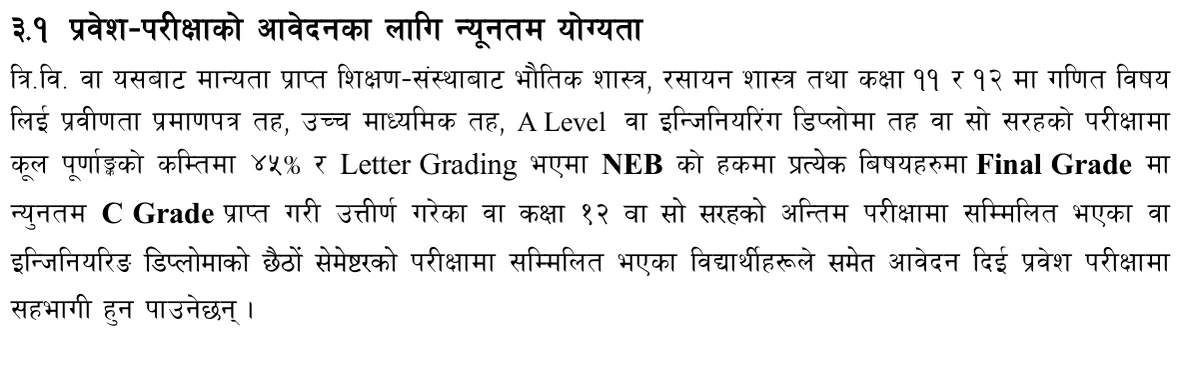
To sit the IOE entrance you need Physics, Chemistry and Mathematics, with Mathematics taken in classes 11 and 12, from Tribhuvan University or an institution TU recognises. The qualifying examination can be the Proficiency Certificate Level, higher secondary, A Level, an engineering diploma or an equivalent, and the result must be either 45% of total marks or, where letter grading applies, a minimum C Grade in every subject in the NEB Final Grade. You do not need the certificate in hand: candidates who have appeared in the class 12 or equivalent final examination, or in the sixth-semester examination of an engineering diploma, may apply and sit. What the bar does not do is set a score. There is no published minimum in the entrance itself that separately qualifies you to apply for a campus, and your +2 result carries no weight in your rank, because the entrance result carries 100% of the merit weighting on its own.
What exactly does the academic requirement say?
- Physics, Chemistry and Mathematics taken in classes 11 and 12.
- From Tribhuvan University or an institution it recognises.
- Proficiency Certificate Level, higher secondary, A Level, an engineering diploma, or an equivalent examination.
- A minimum of 45% of total marks. Under letter grading, NEB candidates need a minimum C Grade in every subject in the Final Grade.
The two conditions are alternatives rather than a pair to satisfy together, because they belong to two different marking systems. A percentage-marked certificate is read against 45% of the total; a letter-graded NEB certificate is read against a C Grade floor applied subject by subject in the Final Grade, so a single D in any subject is disqualifying even where the aggregate looks comfortable.
Can you apply before your result arrives?
Yes. Candidates who have appeared in the class 12 or equivalent final examination, or in the sixth-semester examination of an engineering diploma, may apply and sit the entrance. You are not excluded for waiting on a result, and the booklet names both cases explicitly rather than leaving them to interpretation.
Does a strong +2 help your rank?
No. The entrance result carries 100% of the weight, so your +2 marks decide whether you are eligible to sit and nothing more. A strong +2 does not lift your rank and a weak one does not lower it, provided you clear the eligibility bar. The one place +2 marks reappear is the third level of the tie-break, and only when two candidates are otherwise exactly level.
Is there a minimum entrance percentage to apply for a campus?
Not one that is published in advance. The rule is that applicants whose names appear in the merit list may apply for campus admission, and IOE sets the qualifying percentage for that list each year rather than fixing it in the booklet. Anyone quoting you a standing pass percentage for that step is inventing it.
Sections 3.1 and 3.2 of the booklet, printed page 11, read off a rendered page image rather than extracted text: an earlier text extraction of this same section produced a plausible and entirely fictitious “37%” threshold that does not exist in the document. Confirm the current year’s wording, grade conversion and document rules in that year’s booklet. The same PDF was re-downloaded and re-checked on 31 August 2026 and is unchanged.
Sources
- IOE B.E./B.Arch Booklet 2083published 7 August 2026 · read 18 August 2026
Last reviewed by Ram Raj Thapa, Admissions Officer, Imperial College of Engineering. Every figure on this page is cited to the document it came from.