
How does IOE reservation work, and what are the quota percentages?
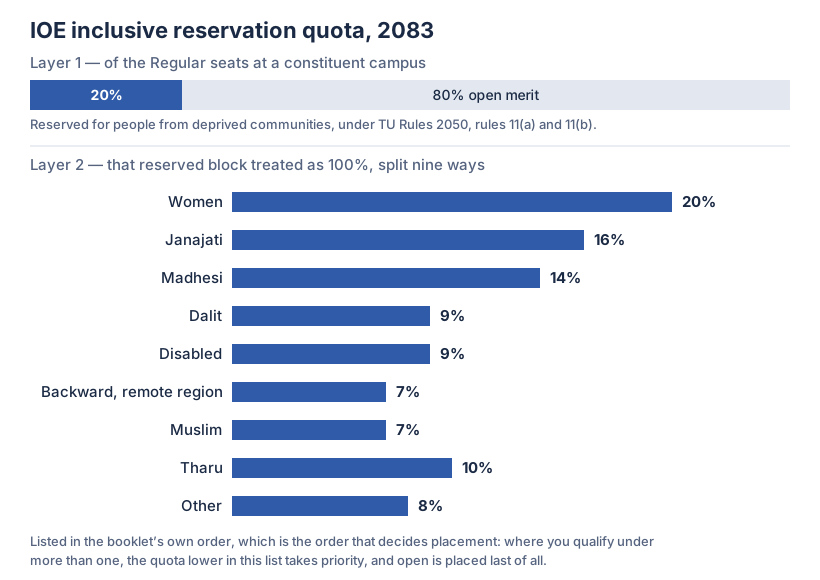
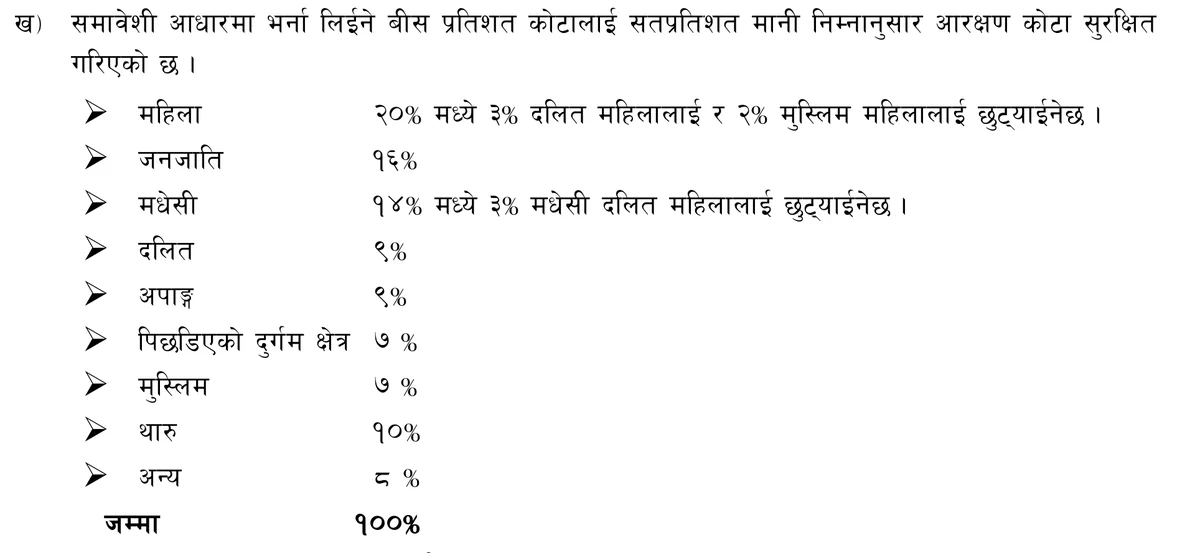
Twenty per cent of the Regular seats at IOE constituent campuses is reserved for deprived communities, and that block is itself split nine ways: women 20%, Janajati 16%, Madhesi 14%, Dalit 9%, disabled 9%, backward and remote region 7%, Muslim 7%, Tharu 10% and other 8%.
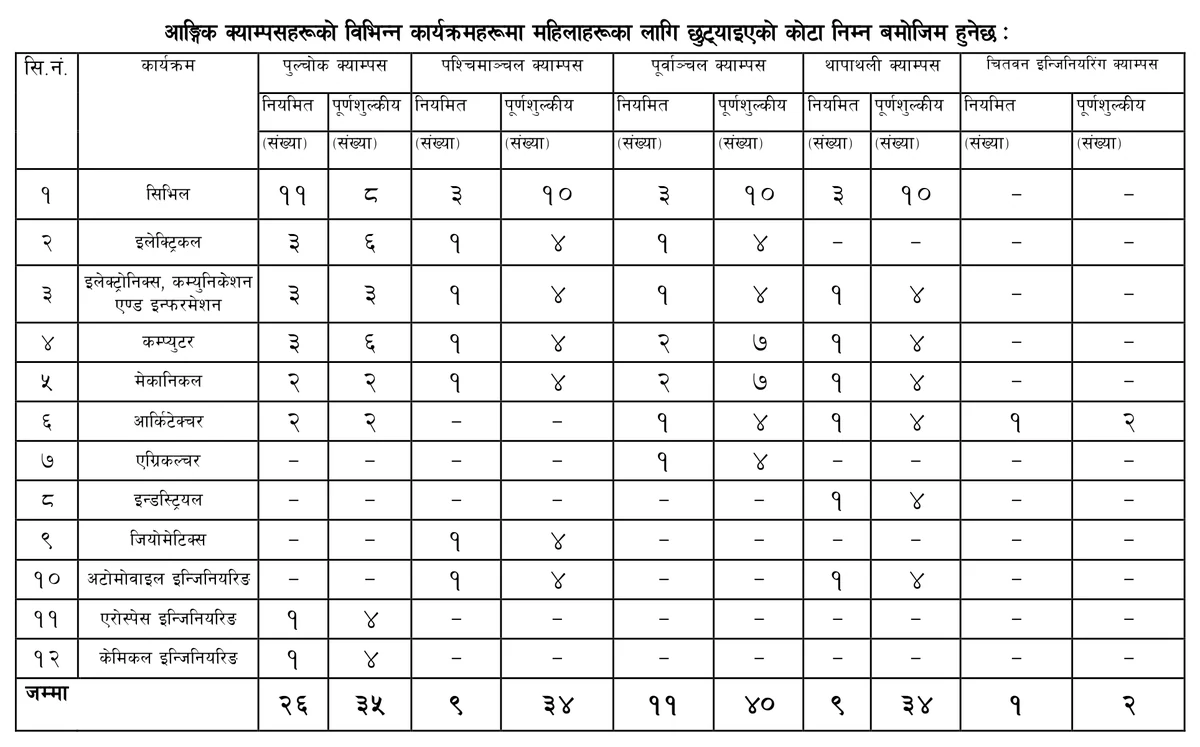
Two layers sit on top of each other here, and confusing them is the usual mistake. First, under Tribhuvan University’s Organisation and Educational Administration Rules 2050, rules 11(a) and 11(b), twenty per cent of the total Regular seats at IOE constituent campuses is reserved for people from deprived communities. Then that twenty per cent block is itself treated as one hundred per cent and divided nine ways: women 20%, Janajati 16%, Madhesi 14%, Dalit 9%, disabled 9%, backward and remote region 7%, Muslim 7%, Tharu 10% and other 8%. Those nine shares sum to exactly 100. Because it is a percentage of a percentage the seats are few: Civil at Pulchowk carries 22 inclusive places, the largest single allocation anywhere in the system, and every other programme carries between one and seven. Adding the booklet’s own per-programme rows gives 119 inclusive seats across the five constituent campuses.
Layer one: a fifth of the Regular seats
Under TU Rules 2050, rules 11(a) and 11(b), twenty per cent of the total Regular seats at constituent campuses is reserved for persons from deprived communities. It is measured on the Regular side only. Nothing in the inclusive quota touches the Full Fee pool, and a Full Fee applicant who applies to it has that application cancelled automatically.
Layer two: that 20% treated as 100%
The categories below are in the booklet’s own printed order, because that order is what decides placement when somebody qualifies under more than one. The last column counts the same list from the bottom: 1st is placed first.
| Category | Share of the reserved block | Placement order |
|---|---|---|
| Women | 20%, of which 3% for Dalit women and 2% for Muslim women | 9th |
| Janajati (indigenous nationalities) | 16% | 8th |
| Madhesi | 14%, of which 3% for Madhesi Dalit women | 7th |
| Dalit | 9% | 6th |
| Disabled | 9% | 5th |
| Backward and remote region | 7% | 4th |
| Muslim | 7% | 3rd |
| Tharu | 10% | 2nd |
| Other | 8% | 1st |
Scroll the table sideways for Placement order.
What does that mean in real seats?
At Pulchowk, Civil carries 22 inclusive seats, divided as 4 women, 3 Janajati, 3 Madhesi, 2 Dalit, 2 disabled, 2 remote region, 2 Muslim, 2 Tharu and 2 other. Every other programme in the system carries between two and seven, and Chitwan Engineering Campus carries one inclusive seat in total. Adding the booklet’s own per-programme rows gives 119 inclusive seats across the five campuses: Pulchowk 55, Purwanchal 25, Paschimanchal 19, Thapathali 19 and Chitwan 1. The booklet prints the rows but not that total, so it is arithmetic on published figures rather than a published figure itself.
Who actually qualifies for one of these seats?
Belonging to one of the nine categories is necessary and nowhere near sufficient. The booklet attaches conditions that rule out a large share of applicants before category is even considered: schooling at a government or community school, a first-attempt pass at 11 and 12, a local-level recommendation that your family is below the poverty line, and a certificate from a named authority for your particular category. Those conditions are set out in full in the answer on who qualifies for the inclusive quota.
This is separate from the general women’s quota
The ten per cent women’s reservation across both Regular and Full Fee programmes is a different provision under section 6.1. The women’s share inside the inclusive block is additional to it and sits only on the Regular side, so the two are not the same seats.
What if you qualify under more than one category?
This is the part that decides where your name actually appears, and the booklet settles it rather than leaving it to the campus. Applying under several categories does not multiply your chances: you are placed in exactly one, and a printed order of precedence chooses which. Taking the categories in the order the booklet prints them — women, Janajati, Madhesi, Dalit, disabled, backward and remote area, Muslim, Tharu, other — the category appearing later in that order takes first priority, the ones before it follow in descending order, and open is placed last of all.
The booklet works its own example. An applicant who applies under women and Janajati as well as open is placed in the Janajati quota automatically, because Janajati falls after women in that order; the women-quota priority is considered next, and open only after that. The practical effect is that the narrower category you are entitled to is usually the one you are placed in, whether or not it is the one you would have picked.
Three limits that complete the picture
- Where a reserved quota is not filled by applicants entitled to it, those seats are published to open applicants rather than held.
- The reservation facility may be used at only one level of study, so it is not something you can draw on again for a later degree.
- A false declaration used to obtain a reserved seat cancels the admission and is dealt with under the law.
Section 6.3 of the booklet, pages 13 to 16, under TU Rules 2050 rules 11(a) and 11(b) and TU’s Reservation Seat Admission Bylaw 2074. The nine shares sum to 100% of the reserved block. The order of precedence, the worked women-and-Janajati example and the unfilled-quota rule are printed in the notes under the per-campus tables on page 15; the one-level limit, the automatic cancellation of a Full Fee applicant’s reservation application and the false-declaration clause are at 6.3(d), (f) and (g), pages 15 and 16. Every figure was verified against a rendered image of its page, because the booklet sets its Nepali in a legacy font that does not survive copying, and each per-campus table was re-added against its own printed total.
Sources
- IOE B.E./B.Arch Booklet 2083published 7 August 2026 · read 18 August 2026
Last reviewed by Ram Raj Thapa, Admissions Officer, Imperial College of Engineering. Every figure on this page is cited to the document it came from.