
How many IOE seats are reserved for women, by campus and programme?
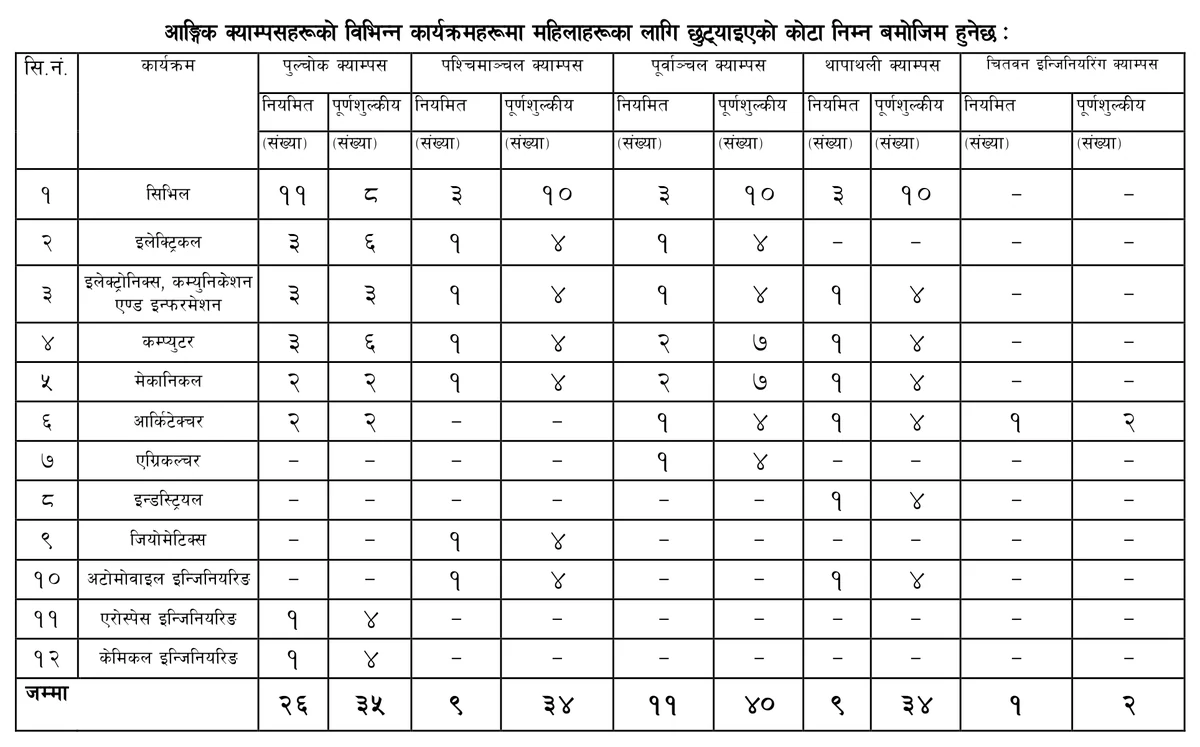
Across the five constituent campuses, 56 Regular and 145 Full Fee seats. IOE publishes the women’s quota as an actual seat count for every programme at every campus, and the whole table is transcribed below.
The ten per cent women’s reservation is not published only as a percentage. IOE prints it as an actual seat count for every programme at every constituent campus, and the totals are 56 Regular and 145 Full Fee places across the five campuses: Pulchowk 26 Regular and 35 Full Fee, Purwanchal 11 and 40, Paschimanchal 9 and 34, Thapathali 9 and 34, and Chitwan 1 and 2. The largest single block anywhere in the system is Civil at Pulchowk, at 11 Regular and 8 Full Fee. Civil at Paschimanchal, Purwanchal and Thapathali each carry 3 Regular and 10 Full Fee. Most other programmes carry one Regular seat and four Full Fee. The table below is the booklet’s own grid, transcribed cell by cell, and the columns were re-added against its printed totals and reconcile exactly.
The full table, campus by campus
Each cell reads Regular / Full Fee. An em dash means the programme is not offered at that campus, or carries no women’s quota seat there. The last row is the booklet’s own printed total for the campus.
| Programme | Pulchowk | Paschimanchal | Purwanchal | Thapathali | Chitwan |
|---|---|---|---|---|---|
| Civil | 11 / 8 | 3 / 10 | 3 / 10 | 3 / 10 | — |
| Electrical | 3 / 6 | 1 / 4 | 1 / 4 | — | — |
| Electronics, Communication and Information | 3 / 3 | 1 / 4 | 1 / 4 | 1 / 4 | — |
| Computer | 3 / 6 | 1 / 4 | 2 / 7 | 1 / 4 | — |
| Mechanical | 2 / 2 | 1 / 4 | 2 / 7 | 1 / 4 | — |
| Architecture | 2 / 2 | — | 1 / 4 | 1 / 4 | 1 / 2 |
| Agriculture | — | — | 1 / 4 | — | — |
| Industrial | — | — | — | 1 / 4 | — |
| Geomatics | — | 1 / 4 | — | — | — |
| Automobile | — | 1 / 4 | — | 1 / 4 | — |
| Aerospace | 1 / 4 | — | — | — | — |
| Chemical | 1 / 4 | — | — | — | — |
| All programmes | 26 / 35 | 9 / 34 | 11 / 40 | 9 / 34 | 1 / 2 |
Scroll the table sideways for Paschimanchal and Purwanchal and Thapathali and Chitwan.
What the shape of the table tells you
Two things worth reading off it. The Full Fee column is almost always larger than the Regular one, so most of the women’s quota is on the side you pay for rather than the subsidised side. And Chitwan Engineering Campus appears with a single row: Architecture, at 1 Regular and 2 Full Fee, which is its entire women’s quota.
How the provision actually operates
It is a floor rather than a cap, applied after the general list. Where ten per cent women applicants have not been selected in the published admission list on general merit, women who meet the minimum eligibility are then published in the admission list in merit order to make the ten per cent up. Nobody who already qualified on open merit is displaced, and the entrance requirement does not change.
The table also tells you which programmes a campus runs
Read down the columns and the grid doubles as a rough map of the system, with the caveat this page already carries: a blank cell means either that the campus does not teach the programme or that it carries no women’s quota seat in it. On that reading, Pulchowk is the only constituent campus with an Aerospace or a Chemical Engineering row. Geomatics appears at Paschimanchal alone, Agriculture at Purwanchal alone, and Industrial at Thapathali alone. Automobile appears at Paschimanchal and Thapathali. Architecture appears at Pulchowk, Purwanchal, Thapathali and Chitwan but not at Paschimanchal, and Chitwan carries Architecture and nothing else. Civil, Computer and Mechanical are the three that appear at four campuses each, and Electrical is absent from Thapathali and Chitwan. If a programme is missing from the column you are reading, that campus is not where you apply for it.
Which seats these are, and which they are not
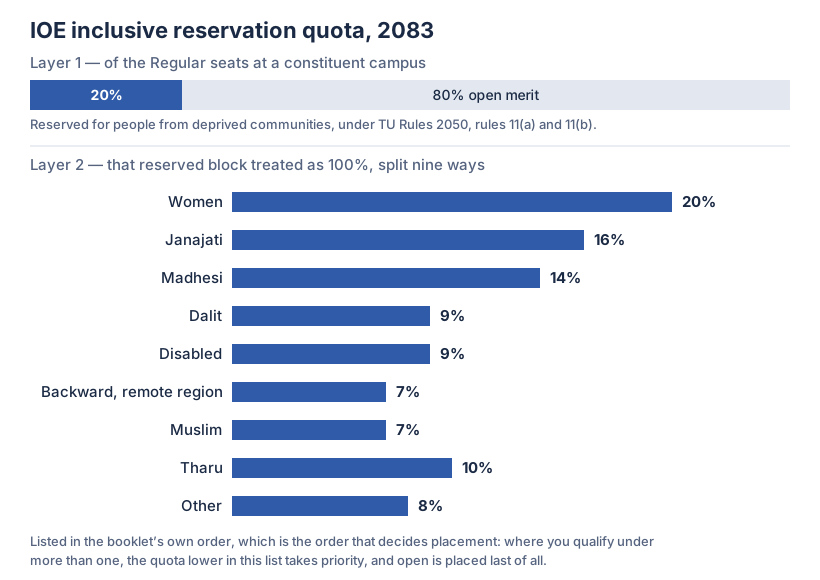
This provision covers both Regular and Full Fee. The women’s share inside the separate twenty per cent inclusive quota is an additional allocation and sits only on the Regular side, so the two are not the same seats and should not be added together casually.
Section 6.1 of the BE/B.Arch Booklet 2083, page 13. Every cell was read off a rendered image of that page rather than from extracted text, because the booklet sets its Nepali in a legacy font that does not survive copying, and each of the ten campus columns was re-added against its own printed total. The booklet notes that its provisions may be amended by the authority.
Sources
- IOE B.E./B.Arch Booklet 2083published 7 August 2026 · read 18 August 2026
Last reviewed by Ram Raj Thapa, Admissions Officer, Imperial College of Engineering. Every figure on this page is cited to the document it came from.