
What is the difference between an IOE Regular and Full Fee seat?
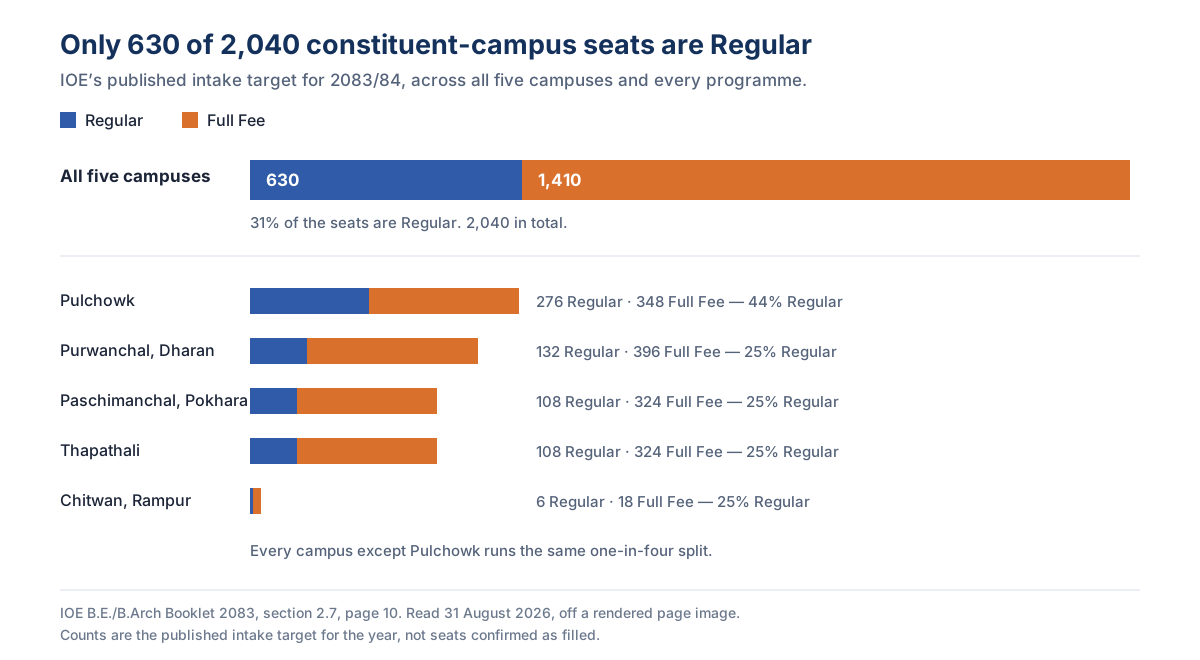
Regular seats are heavily subsidised and allocated on merit; Full Fee seats cost roughly nine times as much for the same degree. Only 630 of the 2,040 seats at IOE's five constituent campuses are Regular.
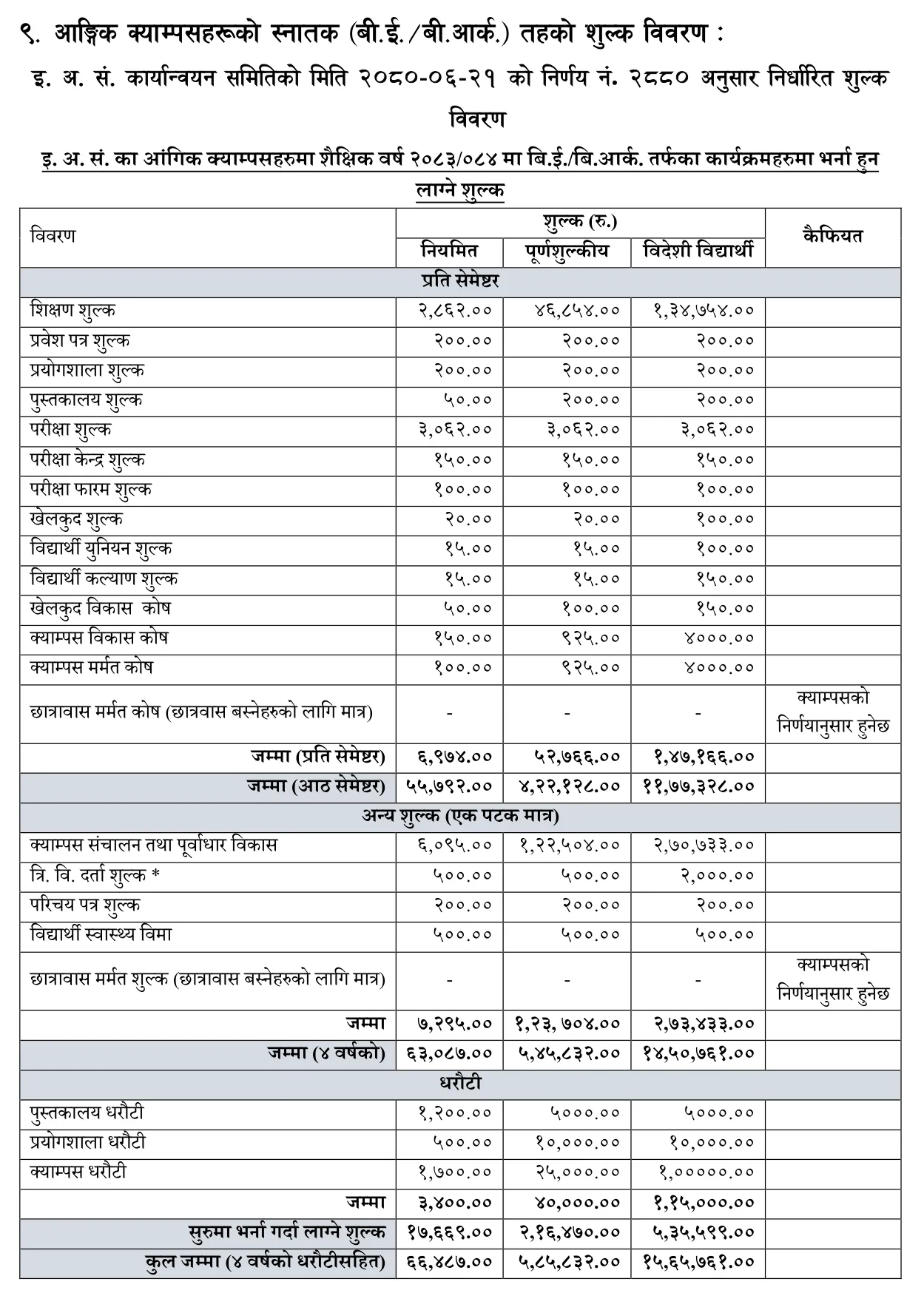
Both categories sit at the same campus, follow the same curriculum, sit the same examinations and receive the same Tribhuvan University degree. Which pool you land in is decided by your position on the merit list, not by anything you choose. Four years on a Regular seat costs about Rs 63,087, with Rs 17,669 due at first admission; the same four years on a Full Fee seat costs about Rs 5,45,832, with Rs 2,16,470 due on the first day. That is a ratio of roughly 8.6 to one. Pulchowk runs 276 Regular seats against 348 Full Fee; the other four campuses each set exactly one Regular seat in four. One move between the pools is allowed after admission, and it runs only in the direction you would want.
- Regular
- Minimum tuition. About Rs 63,087 for four years, Rs 17,669 due at first admission
- Full Fee
- About Rs 5,45,832 for four years, Rs 2,16,470 due at first admission
- Ratio
- A Full Fee seat costs roughly 8.6 times a Regular seat
- Same
- Curriculum, examinations, academic calendar, and the degree awarded
How many of each seat actually exist?
The booklet publishes an intake target for every constituent campus and programme, which turns "allocated on merit" into a number. Across all five campuses the target is 2,040 seats, of which 630 are Regular and 1,410 are Full Fee. Pulchowk is the outlier at 44% Regular; every other campus is set at exactly 25%.
| Campus | Regular | Full Fee | Total |
|---|---|---|---|
| Pulchowk | 276 | 348 | 624 |
| Purwanchal, Dharan | 132 | 396 | 528 |
| Paschimanchal, Pokhara | 108 | 324 | 432 |
| Thapathali | 108 | 324 | 432 |
| Chitwan, Rampur | 6 | 18 | 24 |
| All five campuses | 630 | 1,410 | 2,040 |
Scroll the table sideways for Full Fee and Total.
Why does it matter when you set your priority order?
Where a campus runs both, they are separate pools with separate counts, and being allocated to one rather than the other changes the cost of your degree by several lakh. A campus with a large total intake is not necessarily the one with the most Regular seats, so read the two columns separately. Confirm which list you are on before you commit, and ask in writing.
Can you move from Full Fee to Regular later?
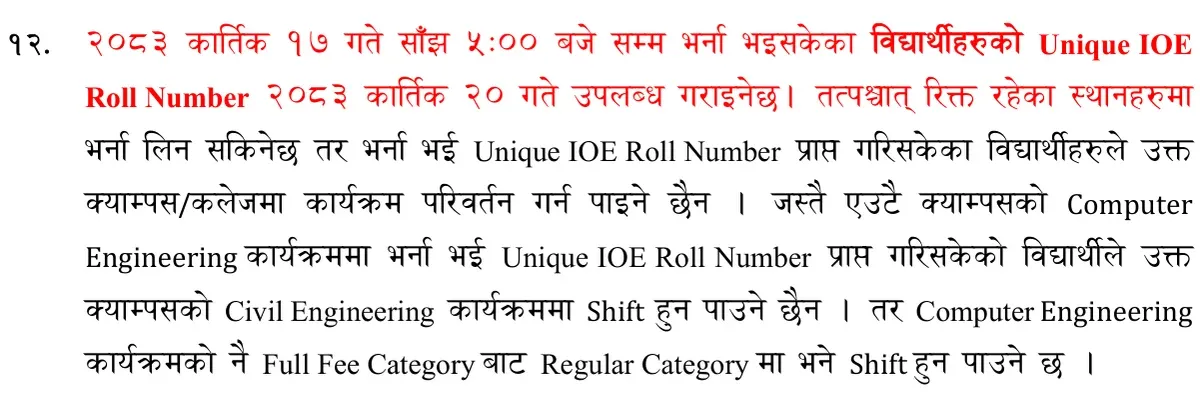
Yes, and this is the one flexibility in the system. The 2083 admission procedure states that a student who has already been issued a Unique IOE Roll Number may not change programme at that campus, then makes one explicit exception: a shift from the Full Fee category to the Regular category within the same programme is allowed. Its own worked example is a Computer Engineering student who may not move to Civil, but may move from Full Fee to Regular in Computer.
Roll numbers for the 2083 intake were issued on 2083 Kartik 20, which is 5 November 2026, to everyone admitted by 5:00 pm on Kartik 17. So the restriction bites from that point, and the Full-Fee-to-Regular route survives it. It is worth asking your campus periodically rather than assuming the categories are fixed for four years.
Where the two categories are actually defined
In one sentence of the booklet, and it is worth reading because it explains the shape of everything else. Describing the admission arrangement at its five constituent campuses, IOE says applicants are admitted under two kinds of tuition fee: students taken as regular pay the minimum tuition fee, and the remaining applicants may be admitted paying the fee set under the full-fee programme. So Full Fee is defined as the residual rather than as a product. It is what a campus does with the applicants its subsidised places did not reach, which is why the ratio between the two prices is so large and why no campus advertises the second category as an option.
Fee figures from the booklet, section 9, page 20; seat counts from section 2.7, page 10, read off a rendered page image and reconciled against the printed grand total of 2,040. The category-shift rule and the roll-number dates are item 12 of the IOE Centralised Admission Monitoring Committee's 2083 admission operating procedure, not the booklet. Reservation rules apply within both pools, including a 10% reservation for women applicants in each.
Sources
- IOE B.E./B.Arch Booklet 2083published 7 August 2026 · read 31 August 2026
- IOE Admission Guidelines 2083 (Centralized Admission Monitoring Committee)published 12 August 2026 · read 31 August 2026
Last reviewed by Ram Raj Thapa, Admissions Officer, Imperial College of Engineering. Every figure on this page is cited to the document it came from.