
How much does a BE actually cost in Nepal?
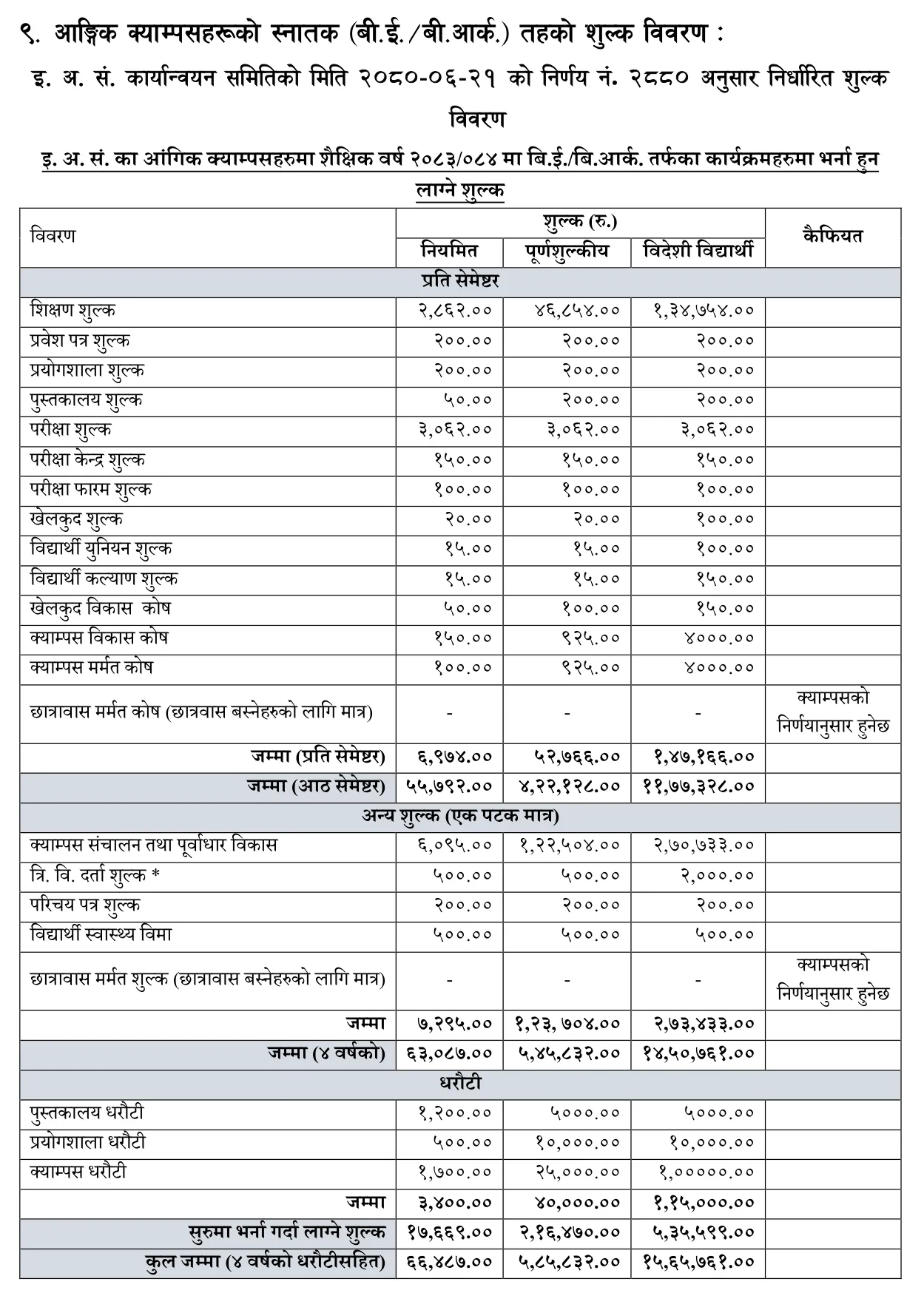
At an IOE constituent campus, about Rs 63,087 for four years on a Regular seat and about Rs 5,45,832 on a Full Fee seat, with Rs 2,16,470 payable on the first day of a Full Fee admission.
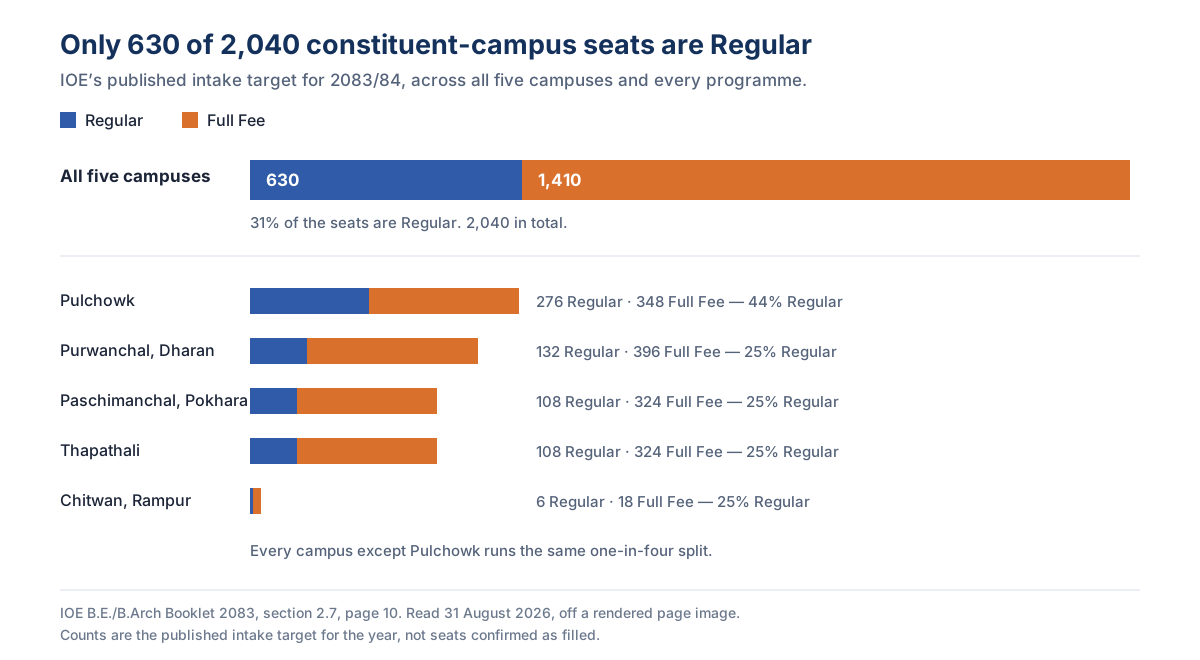
Those are IOE's own published figures for the 2083/084 session, and they are two prices at the same campus for the same degree. The gap between them is where every private-college decision in Nepal gets made, and almost every discussion of engineering fees confuses the two. The Regular price reaches few people: only 630 of the 2,040 seats across the five constituent campuses are Regular seats. A foreign student pays about Rs 14,50,761 for the same four years. None of these totals include a hostel place, which the booklet marks as set by campus decision, or daily transport, which it states is the student's own responsibility. Add both before you compare anything.
| Regular | Full Fee | Foreign | |
|---|---|---|---|
| Tuition per semester | Rs 2,862 | Rs 46,854 | Rs 1,34,754 |
| All charges per semester | Rs 6,974 | Rs 52,766 | Rs 1,47,166 |
| Eight semesters | Rs 55,792 | Rs 4,22,128 | Rs 11,77,328 |
| One-time charges | Rs 7,295 | Rs 1,23,704 | Rs 2,73,433 |
| Four years | Rs 63,087 | Rs 5,45,832 | Rs 14,50,761 |
| Refundable deposits | Rs 3,400 | Rs 40,000 | Rs 1,15,000 |
| Four years with deposits | Rs 66,487 | Rs 5,85,832 | Rs 15,65,761 |
| Payable at first admission | Rs 17,669 | Rs 2,16,470 | Rs 5,35,599 |
Scroll the table sideways for Full Fee and Foreign.
What is the first-day figure made of?
A Full Fee seat at a government campus asks for Rs 2,16,470 on the day you enrol, and that single figure decides more admissions than the four-year total does. It is one semester's charges of Rs 52,766, plus the whole one-time block of Rs 1,23,704, plus all three deposits at Rs 40,000. The same arithmetic gives Rs 17,669 on a Regular seat and Rs 5,35,599 for a foreign student. Nothing in that first payment is spread across the year.
Which lines actually differ between the three columns?
Fewer than you would guess. The examination fee is Rs 3,062, the exam-centre fee Rs 150, the exam-form fee Rs 100, the laboratory fee Rs 200 and the admit-card fee Rs 200 for every student in all three columns. So are the one-time identity-card charge of Rs 200 and the student health insurance of Rs 500.
Two lines carry almost the whole gap. Tuition runs Rs 2,862 a semester on Regular against Rs 46,854 on Full Fee, and the one-time campus operation and infrastructure charge runs Rs 6,095 against Rs 1,22,504. Together those two account for Rs 4,68,345 of the Rs 4,82,745 difference across four years, which is 97% of it. Everything else on the sheet is small change by comparison.
What does the table leave out?
The hostel maintenance line is marked "as per campus decision", so a hostel place at a constituent campus is neither free nor guaranteed. The booklet states separately that arranging daily transport to and from campus is the student's own responsibility, and that a student bears Nepal Engineering Council registration, field study tours and any extra practical classes.
What does this mean for the private option?
A Regular seat is the cheapest engineering education in Nepal by a wide margin and nothing substitutes for it. If your rank reaches one, take it. Below that, the honest comparison is not against Rs 63,087. It is against Rs 5,45,832, because a Full Fee government seat is what a candidate outside the Regular list is choosing between.
Set by IOE Implementation Committee decision 2880 of 2080-06-21 and published in the booklet at section 9, page 20, for the 2083/084 session. Seat counts from the intake table at section 2.7, page 10. Every figure was read off a rendered image of the page rather than extracted text, because the booklet sets its numerals in a legacy Nepali font that does not survive copying; each column was re-added against its own printed totals, which reconciled exactly. The booklet notes that fees are adjusted for each year's new admissions, and its closing note states that the authority may change any provision it prints — so confirm the current year's sheet with the campus.
Sources
- IOE B.E./B.Arch Booklet 2083published 7 August 2026 · read 31 August 2026
Last reviewed by Ram Raj Thapa, Admissions Officer, Imperial College of Engineering. Every figure on this page is cited to the document it came from.