
Do private TU-affiliated engineering colleges have to offer subsidised seats?

Yes. IOE requires each affiliated college to admit 10% of its total intake at a fee equivalent to IOE's Regular rate, without raising its admission target. Across the ten colleges that is roughly 230 seats a year.
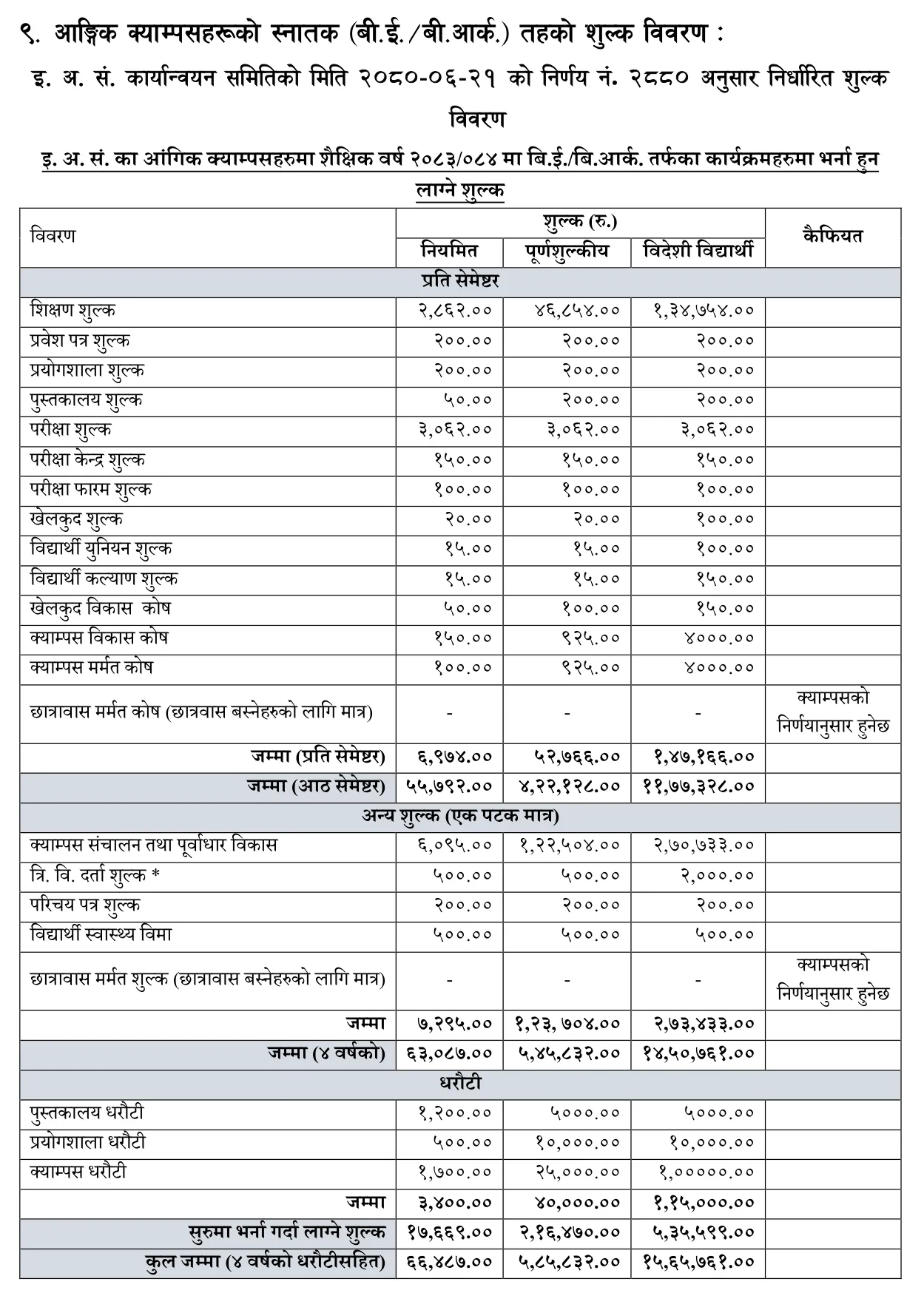
Every TU-affiliated private engineering college carries an obligation almost no student is told about. The booklet requires each of them to admit at 10% of the total admission number at a fee equivalent to IOE's own Regular rate, and it adds the words that matter most: without increasing the admission target. These are not extra seats bolted onto the intake. They come out of seats the college was already going to fill, which is why it is not advertised. IOE's Regular rate is about Rs 63,087 for four years, so one of these seats is worth roughly the difference between that and whatever the college charges everyone else. The same paragraph confirms that passing the IOE entrance is mandatory for admission to an affiliated college too.
How many seats is that at each college?
The booklet publishes an intake target for every affiliated college, which makes the 10% arithmetic concrete rather than abstract. These are those targets and ten per cent of each. The booklet does not say how the figure is rounded where it lands on a fraction, so the right-hand column is the arithmetic, not a quota the college has confirmed.
| College | Intake target | 10% of intake |
|---|---|---|
| Kathmandu Engineering College | 384 | 38 |
| Advanced College of Engineering and Management | 336 | 34 |
| Kantipur Engineering College | 288 | 29 |
| Himalaya College of Engineering | 240 | 24 |
| National College of Engineering | 240 | 24 |
| Kathford International College of Engineering and Management | 192 | 19 |
| Janakpur Engineering College (now Imperial College of Engineering) | 192 | 19 |
| Khwopa College of Engineering | 192 | 19 |
| Sagarmatha Engineering College | 144 | 14 |
| Lalitpur Engineering College | 96 | 10 |
| All ten colleges | 2,304 | 230 |
Scroll the table sideways for 10% of intake.
So across the whole affiliated sector the provision covers roughly 230 seats a year. That is comparable to a mid-sized college's entire intake, and it is spread across ten institutions rather than concentrated anywhere, which is part of why it is easy to miss.
How does it compare with the government seats?
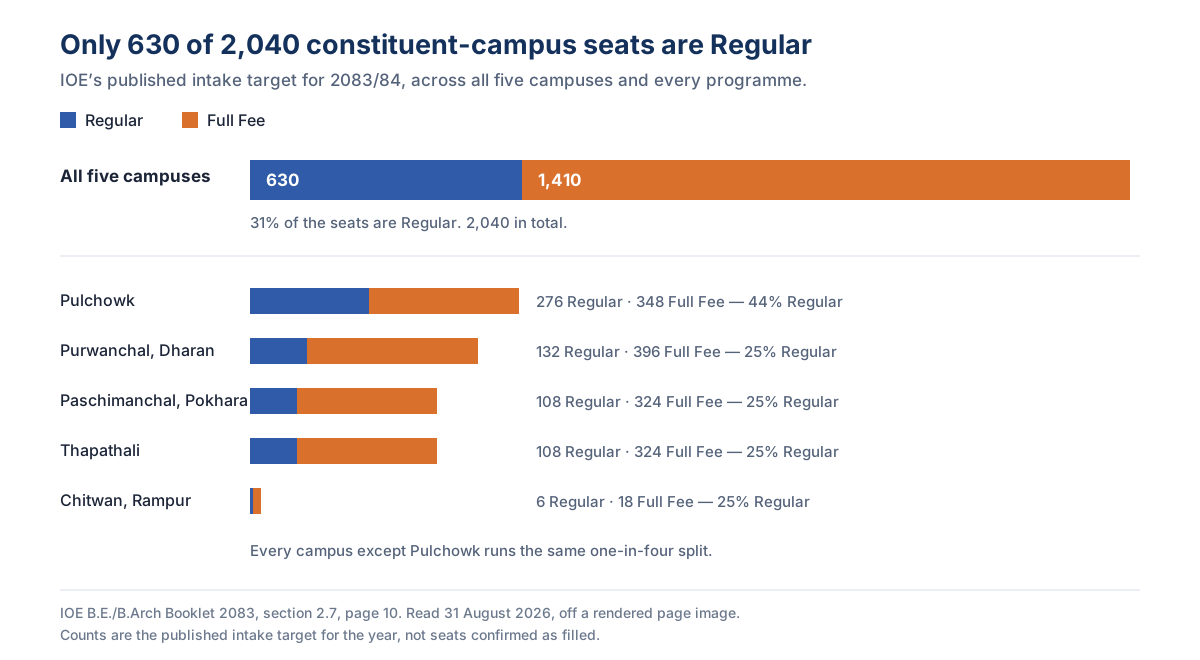
The affiliated sector's 2,304 target is larger than the five constituent campuses' 2,040 between them. But the constituent campuses set 630 of theirs as Regular seats, against roughly 230 subsidised seats across the private sector. So the cheap seat is about three times more available inside the government system than outside it, even though the private system admits more students overall.
What does the booklet not say?
It does not state how those seats are allocated, whether on entrance rank alone, or what the exact rupee figure is at a given college in a given year. So this is a question to put to each college directly rather than an entitlement you can assert.
Four questions to ask, in writing
How many seats do you admit under this provision this year?
What is the total four-year figure for one of them?
How is a student selected for one?
Which seat am I being offered?
What else in this booklet binds a private college?
Less than most people assume, and knowing the short list is how you tell a real obligation from a claim. Section 8.6 names the clauses that extend to TU-affiliated colleges as well as to constituent campuses: section 7.1, which is the admission document checklist; section 7.4, the dual-registration rule; and the whole of section 8, which is admission cancellation, the seven-day absence rule, the deduction ladder and the deposit-refund terms. The 2083 admission procedure adds one more, from outside the booklet: for affiliated campuses, the admission of foreign students and admission under the reserved quotas is governed by what this booklet says. Everything else in the document, the constituent-campus fee table included, is written for the five campuses.
Which is why this provision is unusual
The ten per cent obligation sits in section 2.6, outside that list, and it is one of the few places where the booklet tells a private college what it must do about price. That makes it worth quoting to a college rather than paraphrasing, and it also explains why nothing else about a private college’s fee is fixed by this document. If a college describes any other charge as set by IOE, the reasonable next question is which section.
Section 2.6 of the booklet, page 9. Intake targets read from the affiliated-college intake table on page 10 of the same booklet, verified against a rendered image of the page rather than extracted text, because the booklet sets its figures in legacy Nepali fonts that do not survive copying. Each column total reconciles with its own cells and the ten columns sum to the printed grand total of 2,304, which is the check that the reading is right. The provision applies to all ten TU-affiliated private colleges, so it differentiates none of them; it is a floor, not an offer.
Sources
- IOE B.E./B.Arch Booklet 2083published 7 August 2026 · read 31 August 2026
Last reviewed by Ram Raj Thapa, Admissions Officer, Imperial College of Engineering. Every figure on this page is cited to the document it came from.