
How do engineering scholarships in Nepal actually work?

Three different things are called a scholarship: a subsidised Regular seat, rank-banded pricing at private colleges, and discretionary support assessed case by case.
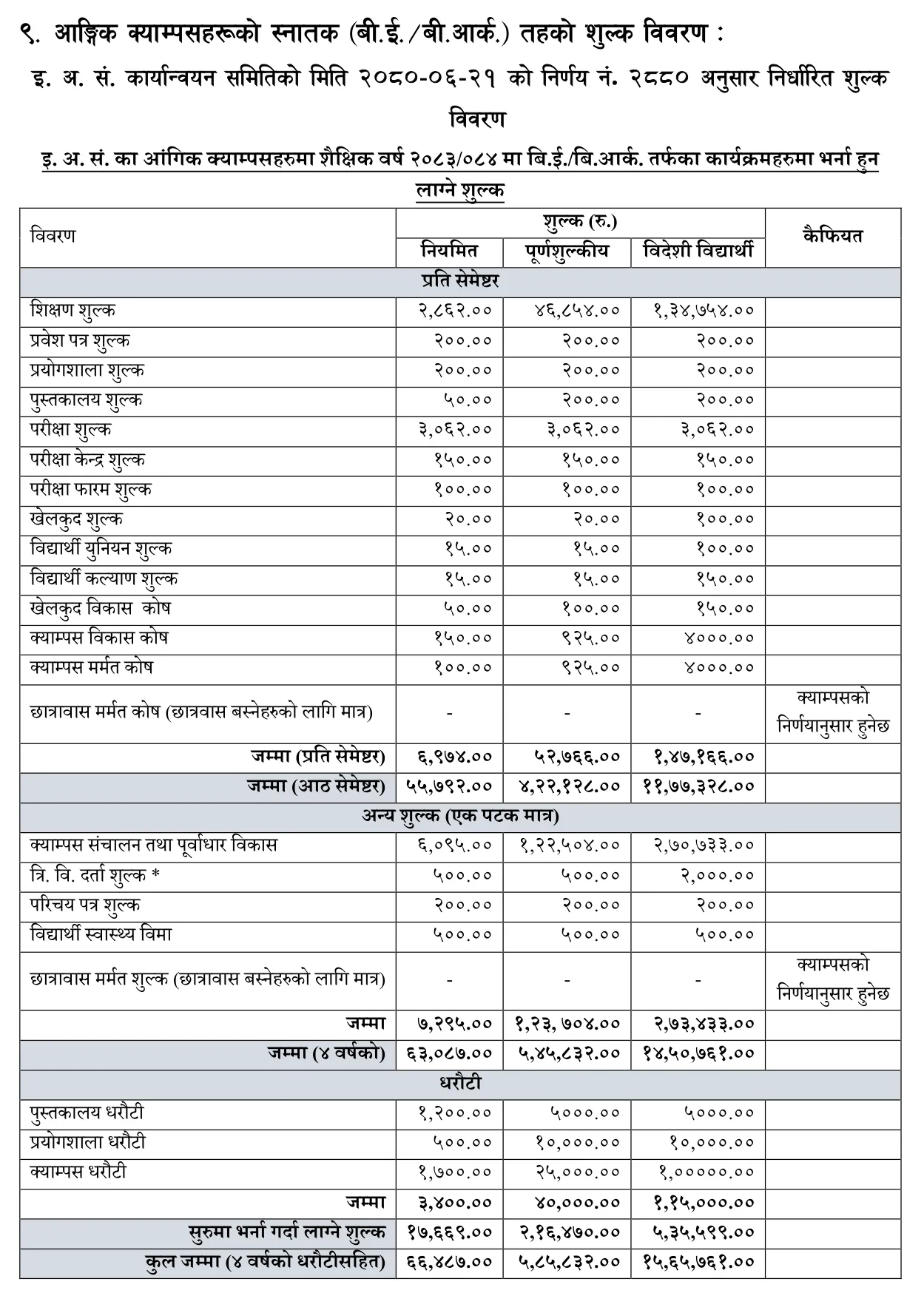
Confusing these three is why fee conversations go badly, because they work in completely different ways and only one of them is negotiable. The first is a subsidised Regular seat at a government campus, which your entrance rank decides and nobody awards: 630 of the 2,040 constituent-campus seats are Regular, and four years on one costs about Rs 63,087. The second is a private college's rank-banded price list, which is a price rather than a scholarship. The third is discretionary support assessed against your documents, which is the only one anybody can vary. A fourth thing exists that nobody calls a scholarship and everybody should: the 10% of every affiliated college's intake that must be admitted at the Regular rate.
One: the Regular seat at a government campus
The genuine subsidy, and not discretionary. Pass the entrance, place high enough on the merit list, and a constituent campus seat costs about Rs 63,087 for four years against Rs 5,45,832 on the Full Fee seat beside it. Nobody awards it and nobody negotiates it. Your rank decides it.
Two: rank-banded pricing at private colleges
Most private colleges price by entrance rank in bands. This is a price list rather than a scholarship, and the honest ones publish it. Ask for it dated and in writing, and check whether the figure quoted is per semester, per year, or for the whole programme.
Three: discretionary support, assessed individually
This is the one that cannot be quoted before anyone has seen your documents, because it depends on your +2 performance, your entrance rank and your family's circumstances. Different students in the same rank band legitimately receive different answers.
And the one nobody calls a scholarship
IOE requires every affiliated private college to admit 10% of its intake at a fee equivalent to the Regular rate, inside its existing target. Across the ten colleges that is roughly 230 seats a year. It is an obligation on the college rather than an award, so it is rarely raised unless you raise it.
What should make you sceptical?
A college that promises a specific percentage before seeing your documents is guessing. A college that will not put the outcome in writing afterwards is worse. The test is not what you are told in the room; it is whether it appears on a signed, dated fee sheet before you pay anything.
What to bring to that conversation
Your entrance scorecard, your +2 transcript, and an honest figure for what your family can pay across four years rather than per semester. Ask for the total, ask what is billed separately, and ask what is due on day one.
Four: the continuing awards inside a government campus
A fourth meaning applies only after you are already enrolled at a constituent campus, and it is the one families most often hear about second-hand. IOE runs a set of continuing scholarships and free studentships sized as percentages of each programme’s regular student count, awarded on the results of the preceding semester and, in first year, on the entrance score. They are not admission discounts and they cannot be arranged in advance, because there is nothing to assess until a result exists. They also do not combine: a student enjoying one type of scholarship or facility is not given another. Anyone offering you one of these before you have enrolled is describing something that has not happened yet.
Five: an employer paying, which is not a discount at all
The sponsored quota is the last thing routinely called a scholarship, and it works in the opposite direction. A government office or a government-owned institution nominates a member of its own staff and pays the fee, by cheque drawn by that institution rather than by the student. Under it the tuition charged is thirty per cent higher than the individual full-fee programme tuition, so a sponsored seat costs more than the seat next to it rather than less. What the candidate gains is that somebody else is paying, which is a different proposition from the price being lower, and worth separating before a family builds a plan on the word.
The Regular and Full Fee figures, the continuing awards and the sponsored quota are from the BE/B.Arch Booklet 2083: the fee table at section 9, page 20, section 13, page 22, and section 6.4, page 17. The ten per cent obligation on affiliated colleges is section 2.6, page 9. Rank-banded private pricing and discretionary support are not IOE provisions and appear in no national document, so the only place to get either is the college itself, dated and in writing.
At Imperial College of Engineering
Our own rank-band table is published and dated, and support beyond it is assessed individually and written onto the fee sheet before any payment. Ask about the 10% Regular-rate provision too, at any college you are considering.
Sources
- IOE B.E./B.Arch Booklet 2083published 7 August 2026 · read 31 August 2026
- ICE published fee structure 2083/84published 14 August 2026 · read 18 August 2026
Last reviewed by Ram Raj Thapa, Admissions Officer, Imperial College of Engineering. Every figure on this page is cited to the document it came from.