
What do foreign students pay for a BE at IOE?
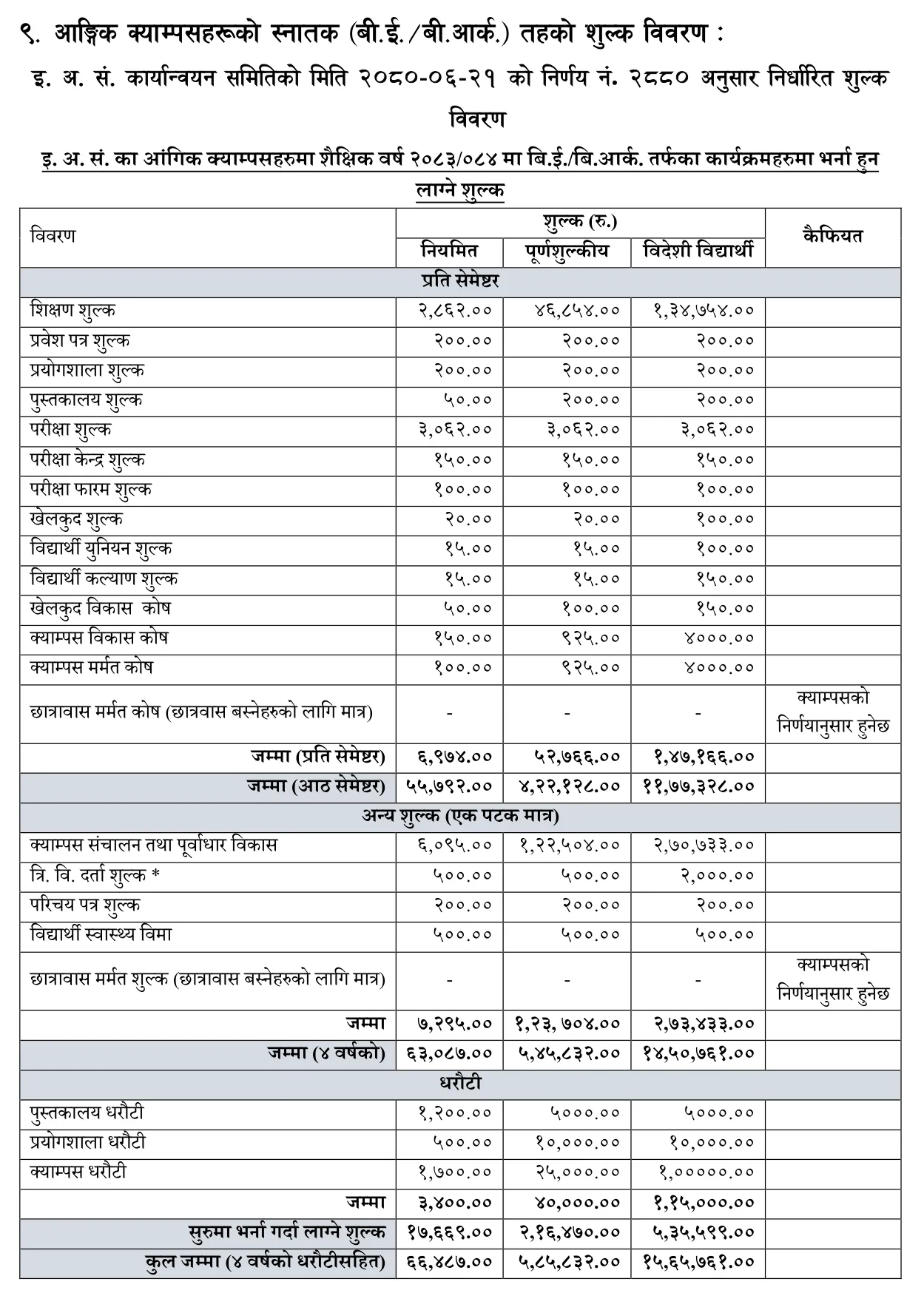
About Rs 14,50,761 for four years at a constituent campus, or Rs 15,65,761 including deposits, with Rs 5,35,599 payable at first admission.
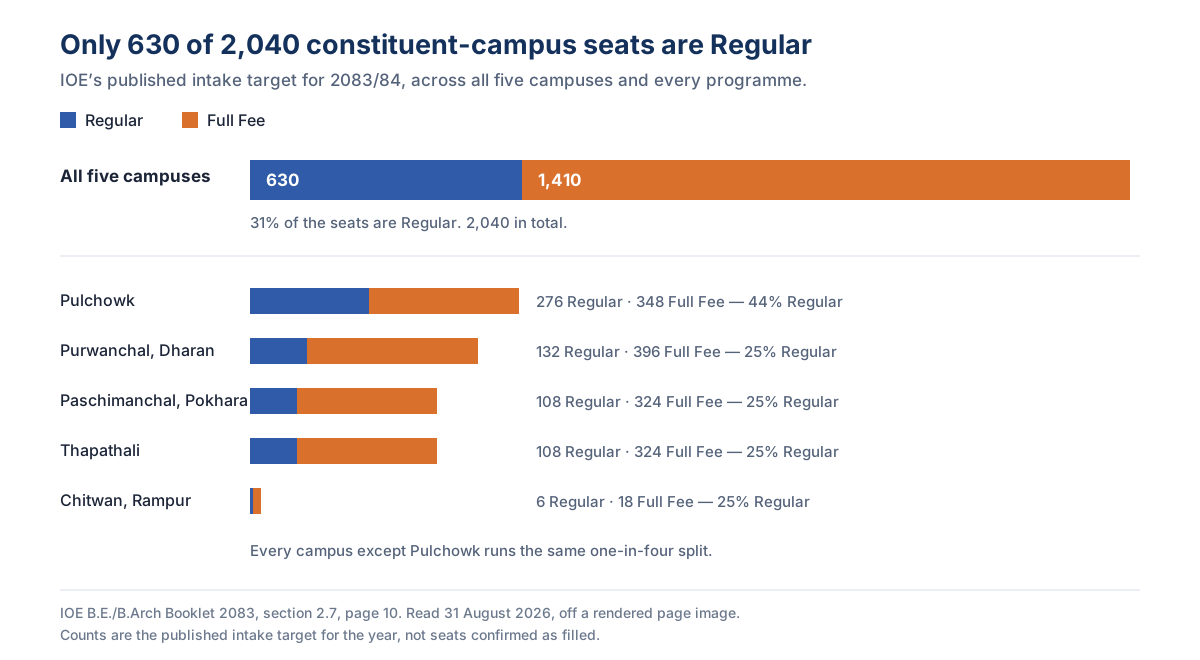
Foreign students are charged on a separate published scale at IOE constituent campuses: roughly 2.7 times the Full Fee rate and about 23 times the Regular rate, for the same degree in the same classroom. Tuition alone is Rs 1,34,754 a semester. The seats are limited as well as expensive — the booklet reserves an amount equal to one twelfth of a campus's Full Fee seats for foreign nationals, so across the 1,410 Full Fee seats in the system that is on the order of 117 places. How you sit the entrance depends on where you studied, and there are three separate routes. Before assuming a government campus is the cheaper option, note that this is the one case where it usually is not.
| Foreign student rate | |
|---|---|
| Tuition per semester | Rs 1,34,754 |
| All charges per semester | Rs 1,47,166 |
| Eight semesters | Rs 11,77,328 |
| One-time charges | Rs 2,73,433 |
| Four years | Rs 14,50,761 |
| Refundable deposits | Rs 1,15,000 |
| Four years with deposits | Rs 15,65,761 |
| Payable at first admission | Rs 5,35,599 |
Which entrance route applies to you?
The booklet sets out three, by where you studied rather than by nationality. They are not interchangeable, and the third is a discretion rather than an entitlement.
| If you are | How you enter |
|---|---|
| A foreign student who studied at a campus or higher secondary school in Nepal | Sit and pass the IOE entrance examination on the same terms as Nepali students |
| A foreign student from a SAARC country | Sit and pass an examination specified by IOE's Entrance Examination Board |
| A foreign student from outside SAARC | May be admitted with the approval of IOE's Entrance Examination Board |
What documents are different?
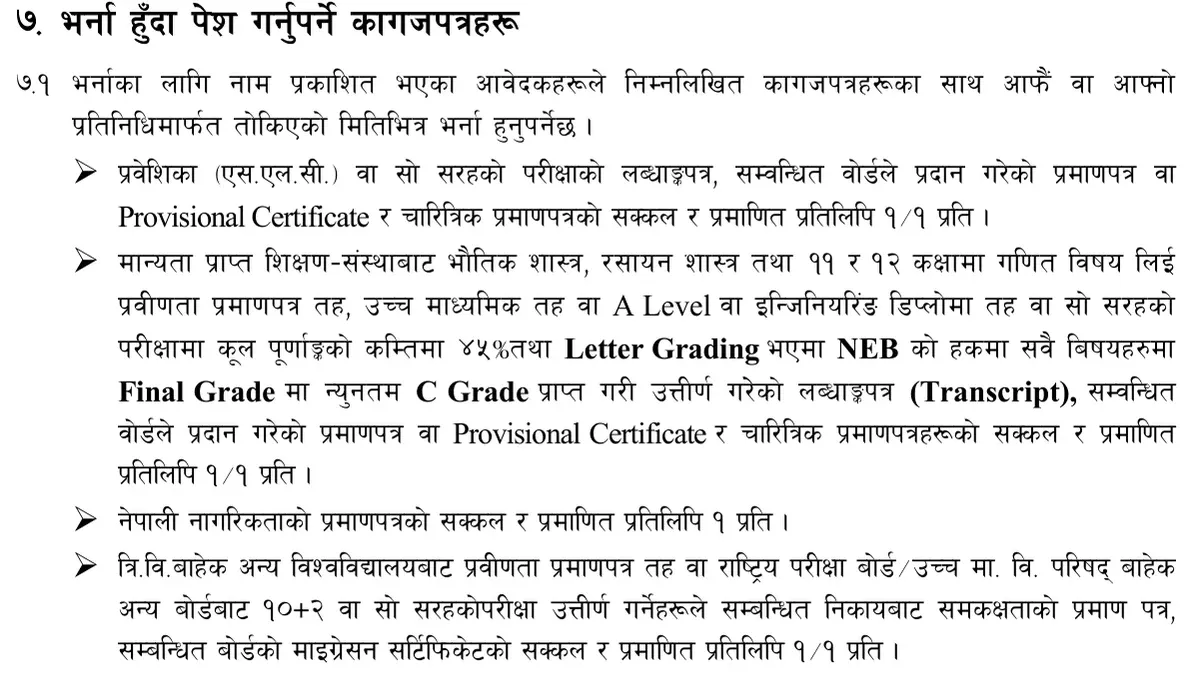
Foreign applicants submit an attested copy of their passport. Indian applicants instead submit an identity certificate with photograph issued by the Indian Embassy in Nepal. Everything else in the admission document list applies as it does to a Nepali candidate.
What is the TU registration charge, exactly?
The fee table's foreign column charges Rs 2,000 for TU registration, while the note attached to that same row says the charge is Rs 500 for a student who passed their qualifying examination inside Nepal and Rs 1,000 for one who passed abroad, and that it applies only to students not already registered with TU. The booklet does not reconcile the Rs 2,000 in the table with the Rs 1,000 in its own note. Ask the campus which figure it collects, because nothing published here settles it.
Is a private college cheaper for an international student?
Often, yes. Because the foreign rate at a government campus is so high, a TU-affiliated private college can work out considerably cheaper for an international student than a constituent campus does. That is the opposite of the position for a Nepali student holding a Regular seat, so do the arithmetic rather than assuming government is cheaper.
The deposit is where the foreign column really separates
The refundable block is Rs 1,15,000 for a foreign student against Rs 40,000 on a Full Fee seat and Rs 3,400 on a Regular one, and almost all of the difference is a single row. The booklet lists three deposits: a library deposit of Rs 5,000, a laboratory deposit of Rs 10,000 and a campus deposit of Rs 1,00,000. The campus deposit alone is two and a half times the entire Full Fee deposit block. It is refundable, but only on the booklet’s own terms: claimable within one year of leaving the campus after completing the syllabus, and forfeited outright by a student who leaves part-way through.
Two ordinary-looking rows are also priced differently
The campus development fund and the campus repair fund each run at Rs 4,000 a semester in the foreign column, against Rs 925 on a Full Fee seat and Rs 150 and Rs 100 on a Regular one. Over eight semesters that is Rs 64,000 from two lines that look like rounding errors on the domestic sheet. It is worth naming because a family comparing headline tuition alone will miss it, and because these are the rows a campus can point to when the totals are questioned.
Fees from section 9, page 20, set by IOE Implementation Committee decision 2880 of 2080-06-21, for the 2083/084 session. Seat reservation and the three entrance routes from section 6.5, pages 17 to 18. Documents from section 7.2, page 18. TU registration note from page 21. The one-twelfth seat figure is the booklet's ratio applied to the published Full Fee intake of 1,410; the booklet prints the ratio, not the resulting count, and does not say how it is rounded at each campus.
Sources
- IOE B.E./B.Arch Booklet 2083published 7 August 2026 · read 31 August 2026
Last reviewed by Ram Raj Thapa, Admissions Officer, Imperial College of Engineering. Every figure on this page is cited to the document it came from.