
Are IOE seats reserved for foreign nationals, and how do they apply?

Yes. A number of seats equal to one twelfth of the full-fee seats at IOE constituent campuses is reserved for foreign nationals, and there are three different entrance routes depending on where you studied and whether your country is in SAARC. The published four-year rate is Rs 14,50,761.
IOE reserves a number of seats equal to one twelfth of the full-fee seats at its constituent campuses for foreign nationals, and it sets three different entrance routes rather than one. A foreign student who studied at a campus or higher secondary school inside Nepal sits and passes the entrance examination on the same basis as a Nepali student. A student from a SAARC country sits and passes the examination the IOE Entrance Examination Board designates. A student from a country outside SAARC may be admitted with the approval of that Board. The reservation sits on the full-fee side only, so it does not draw on the subsidised Regular pool. The published foreign rate at a constituent campus is Rs 14,50,761 for four years, Rs 15,65,761 with deposits, and Rs 5,35,599 of it falls due on the first day.
How big is the reservation?
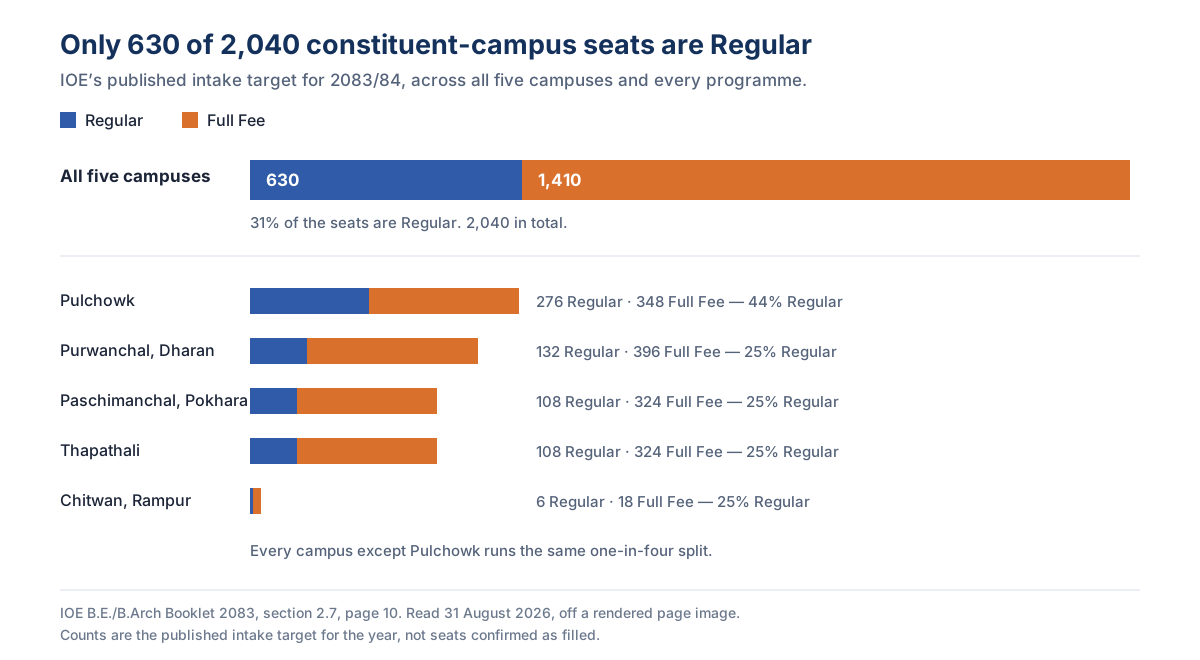
A number of seats equal to one twelfth of the full-fee seats in the full-fee programme at IOE constituent campuses. It is expressed as a fraction of that pool rather than as a fixed count, so the number moves with each campus’s full-fee intake, and it does not touch the Regular seats at all.
The three routes
| Category of applicant | Entrance route |
|---|---|
| Foreign students who studied at a campus or higher secondary school in Nepal | Must sit and pass the entrance examination on the same basis as Nepali students |
| Students from SAARC countries | Must sit and pass the examination designated by the IOE Entrance Examination Board |
| Students from countries outside SAARC | May be admitted with the approval of the Entrance Examination Board |
What the routes have in common
Applicants who meet the minimum eligibility and pass are then eligible for admission at the constituent campuses. Route three is an approval rather than an examination, but it is still an approval you have to obtain in advance rather than a formality applied at the counter.
The documents
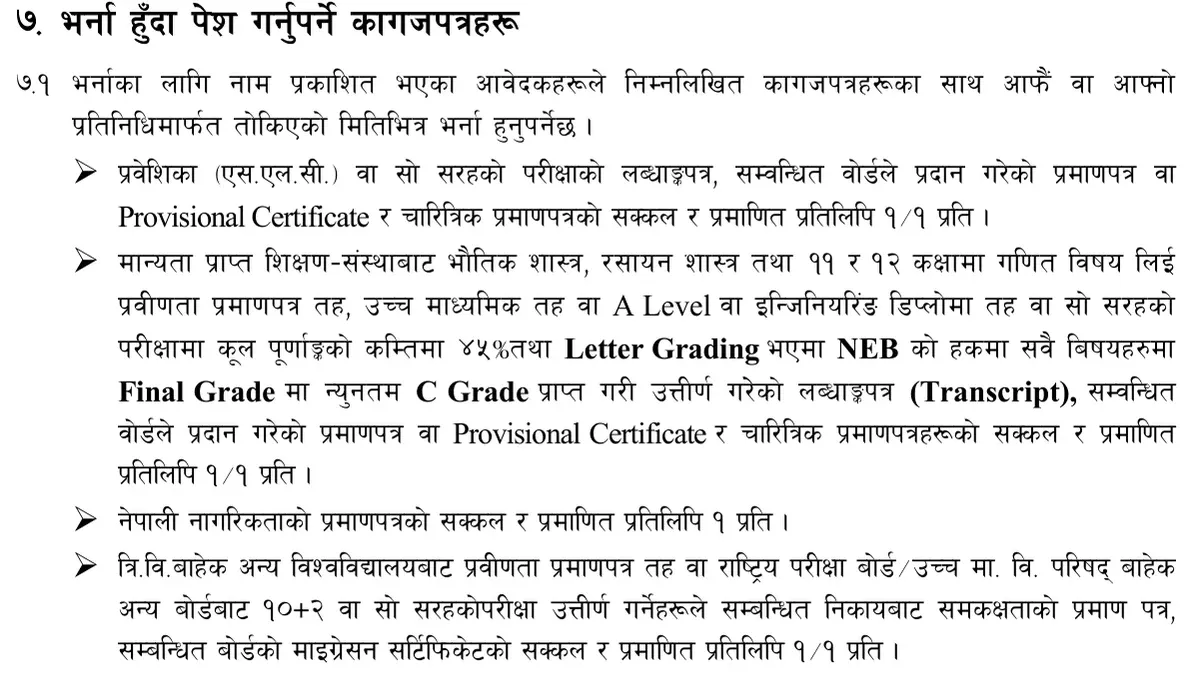
Foreign applicants submit an attested copy of their passport. Indian applicants instead submit an identity certificate with photograph issued by the Indian Embassy in Nepal. The campus does not attest copies for you; the booklet puts that on the applicant.
What does it cost, and is a constituent campus cheaper?
- Per semester
- Rs 1,47,166
- Eight semesters
- Rs 11,77,328
- One-off charges
- Rs 2,73,433
- Four-year total
- Rs 14,50,761
- With deposits
- Rs 15,65,761
- Due on the first day
- Rs 5,35,599
Check that arithmetic before assuming a government campus is the cheaper option. A TU-affiliated private college can work out considerably less for an international student, which is the reverse of the position for a Nepali student holding a Regular seat.
The five-day document deadline applies here too
This quota is section 6.5, and the deadline in the preamble to section 6 covers every route from 6.1 to 6.5. Candidates seeking any of them must submit the required documents at the place IOE designates within five days of the date the entrance result is published, and the booklet adds that no action is taken on documents received after that date. For an applicant abroad that is a genuinely tight window, because it covers obtaining the attested passport copy, or the embassy identity certificate in the Indian case, and physically getting it to Nepal. Assemble the papers before the result rather than after it.
What about a TU-affiliated private college?
The same document, not a separate one. The admission procedure for the 2083 cycle states that for affiliated campuses, the admission of foreign students and admission under the various reserved quotas is governed by what the BE/B.Arch information booklet says. So a private TU-affiliated college is working from the clauses on this page rather than from a policy of its own, and a rule quoted to you that has no counterpart in the booklet is worth asking about in writing.
One registration, in one country
If an applicant is found to be registered at the same time for the same or an equivalent course at two universities or institutions, only the certificate obtained by registering at the Nepali institution is recognised. That clause matters most to exactly this group, because holding a place at home while starting in Nepal is the natural thing to do, and the booklet treats it as a choice rather than as insurance.
Section 6.5 of the BE/B.Arch Booklet 2083, pages 17 and 18, with the documents from section 7.2 and the dual-registration rule at 7.4, page 18, and the five-day deadline from the preamble to section 6, page 12. The affiliated-college position is item 7 of the IOE Admission Guidelines 2083, page 3. Fee figures are the foreign-student column of the fee table in section 9, page 20, read off a rendered page image and re-added against its own printed totals. The attestation rule is the standing note on page 25.
Sources
- IOE B.E./B.Arch Booklet 2083published 7 August 2026 · read 18 August 2026
- IOE Admission Guidelines 2083 (Centralized Admission Monitoring Committee)published 12 August 2026 · read 18 August 2026
Last reviewed by Ram Raj Thapa, Admissions Officer, Imperial College of Engineering. Every figure on this page is cited to the document it came from.