
What engineering costs are not covered by the published fee?

Nepal Engineering Council registration, field study tours, extra subjects and additional practical classes, hostel charges, and TU registration if you are not already registered.
The published fee tables are not the whole cost of a degree, and the booklet is unusually direct about it: a short list of notes under the fee section names the charges the student carries directly. None of them are large next to a programme fee, but they are cumulative and they are invisible on every comparison table published anywhere. The two that move a family's answer are not on the list at all, because the booklet deals with them elsewhere — a hostel place is set by each campus's own rules, and arranging daily transport to and from campus is stated to be the student's own responsibility. The booklet also reserves the right to add charges TU specifies later.
What does the student bear?
- Nepal Engineering Council registration and related fees.
- Any academic activity not named in the curriculum: extra subjects, field study tours, additional practical classes.
- Hostel charges, set by the rules of the campus concerned.
- Additional semester fees where a programme runs beyond eight semesters.
- Daily transport to and from campus, at every campus and college in the system.
TU registration, if you are not already registered
- Passed your qualifying exam within Nepal
- Rs 500
- Passed your qualifying exam abroad
- Rs 1,000
- Already registered with TU
- No charge; submit a photocopy of your registration record
Where does the campus development money go?
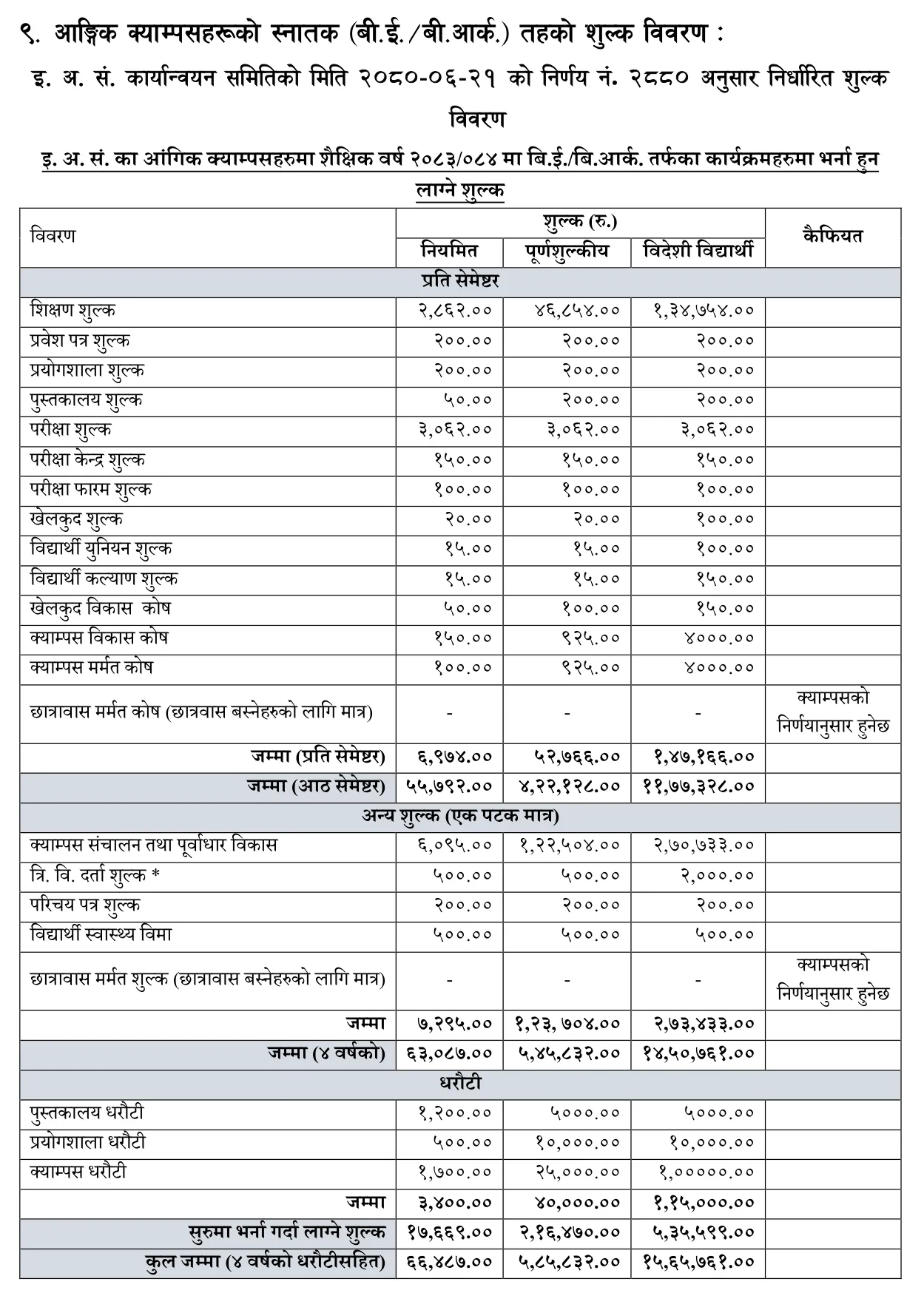
Into a reserve. The booklet's notes state that everything collected under the campus operation and infrastructure development heading — Rs 6,095 on a Regular seat and Rs 1,22,504 on a Full Fee seat, both one-time — must be deposited into the campus's own reserve fund, which the campus may then draw on for current and capital spending. It is the second-largest single line on a Full Fee admission after tuition, so it is worth knowing it is a building fund rather than a service charge.
One more that surprises people
Under the sponsored quota, the tuition fee is 30% higher than the individual full-fee programme tuition. Against the published Full Fee tuition of Rs 46,854 a semester, that is roughly Rs 60,910. The booklet states the uplift but does not print the resulting figure or a sponsored-quota total, and it applies the 30% to tuition only. A sponsored seat is not a discounted seat.
Which small charges are already inside the published fee?
Worth knowing, because it tells you what you should not be asked for a second time. The per-semester block of IOE's own table already carries the admit-card fee, the laboratory fee, the library fee, the examination fee, the examination-centre fee and the examination-form fee, and alongside them a sports fee, a student union fee, a student welfare fee, a sports development fund, a campus development fund and a campus repair fund. The one-off block carries the campus operation and infrastructure charge, the Tribhuvan University registration line, the identity-card charge and a student health insurance line of Rs 500. Every one of those sits inside the four-year totals. If a separate demand arrives for one of them, the question to ask is which row of the published sheet it corresponds to.
The hostel sits outside it twice over
The table carries two hostel rows, a hostel maintenance fund on the per-semester side and a hostel repair charge on the one-off side, and both are printed with no amount in any of the three columns. Against each, the remarks column says the charge will be as the campus decides. So a hostel place at a constituent campus is not merely left out of the totals; it has no published price at all, in a document that prices everything else to the rupee. That absence is the largest single gap between the published fee and a family's real bill, and the only way to close it is to ask the campus in writing before you commit.
How should you use this when comparing colleges?
Ask every college for the total across four years, then ask specifically what sits outside it. NEC registration and field trips apply wherever you study, so they are not a differentiator; hostel and transport very much are, and those are the two that move a family's answer.
From the notes to section 9 (pages 20 to 21), section 6.4 (page 17) and section 16.3 (page 25) of the booklet. The Rs 60,910 figure is 30% above the published Full Fee tuition, worked here rather than printed by the booklet. The booklet also notes that other charges may be added in cases specified by TU, and its closing note states that the authority may change any provision it prints.
Sources
- IOE B.E./B.Arch Booklet 2083published 7 August 2026 · read 31 August 2026
Last reviewed by Ram Raj Thapa, Admissions Officer, Imperial College of Engineering. Every figure on this page is cited to the document it came from.