
What do the BE programme codes BCE, BCT and BEI mean?

BCE is Civil, BCT is Computer, and BEI is Electronics, Communication and Information Engineering. All three award the same degree, a Bachelor of Engineering, so the code names the programme rather than the qualification.
Three letter codes carry the commonest BE programmes through the IOE system, and you meet them on the entrance paperwork, on listings and on the college priority form. BCE is Bachelor of Civil Engineering, BCT is Bachelor of Computer Engineering, and BEI is Bachelor of Electronics, Communication and Information Engineering. Getting them right matters because the priority form asks you to rank college-and-programme pairs, and a code read wrongly is a choice you did not mean to make. The confusion is not hypothetical: at least one major Nepali college directory currently labels Computer Engineering as BCE, which is the code for Civil. IOE’s own 2083 booklet sidesteps the problem by printing programme names in full and never abbreviating them, so the booklet is the document to check when two listings disagree.
| Code | Programme |
|---|---|
| BCT | Computer Engineering |
| BCE | Civil Engineering |
| BEI | Electronics, Communication & Information |
Why does one site say BCE and another say Computer?
Because the codes are conventions used across IOE paperwork rather than something the booklet defines, and directory sites copy each other. BCE is Bachelor of Civil Engineering. It is not Bachelor of Computer Engineering, though a national college directory currently lists it that way. Computer is BCT.
Treat that as a signal about the rest of the page. A listing that has the programme codes wrong is unlikely to have checked the seat count, the fee or the affiliation status either.
Does the code appear on your degree?
No. The booklet states that students who pass every subject of a bachelor-level engineering programme are awarded the Bachelor of Engineering, and that architecture students are awarded the Bachelor of Architecture. There is no separate BCE, BCT or BEI qualification.
So the code identifies which programme you studied, and the award is a BE whichever of the three you take. That also means a fee difference or a cutoff difference between the three is not buying you a different degree.
The full list of names the booklet uses
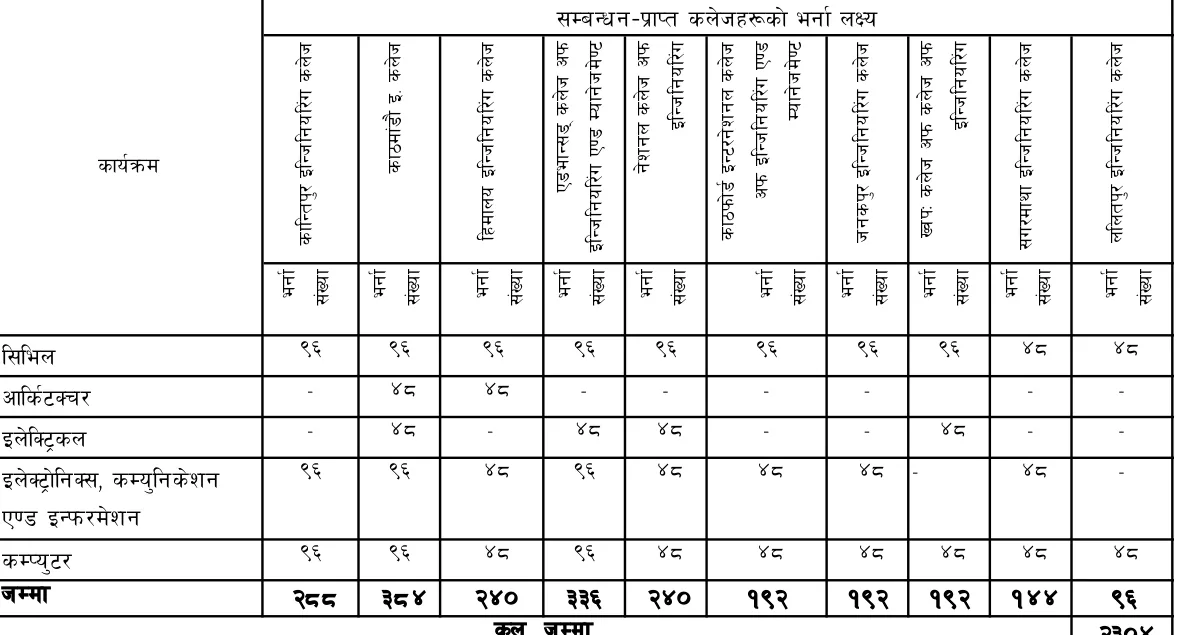
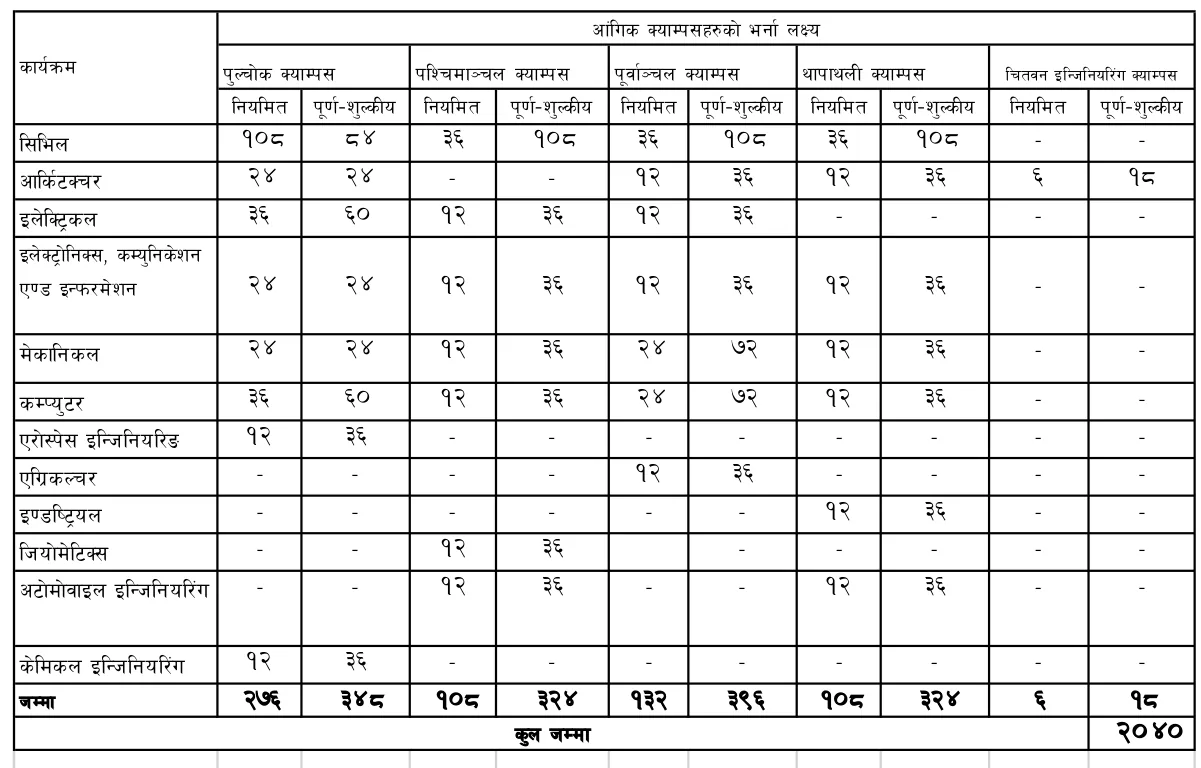
Twelve programmes run at bachelor level across the IOE system in 2083, and the booklet names all of them without codes. Knowing the full names is what lets you match a listing to the official table.
- Civil, Computer, and Electronics, Communication and Information: the three that run at both constituent campuses and private colleges.
- Architecture and Electrical: the other two that private colleges are allowed to run.
- Mechanical, Aerospace, Agriculture, Industrial, Geomatics, Automobile and Chemical: constituent campuses only.
Programme names and the twelve-programme list from the intake tables on page 10 of the booklet; the degree titles from section 11.2.3, page 22. The three-letter codes are the abbreviations used across IOE and college paperwork rather than a definition the booklet gives.
At Imperial College of Engineering
At this college the three programmes carry 96 seats in Civil, 48 in Computer, and 48 in Electronics, Communication and Information, which is 192 in total.
Sources
- IOE B.E./B.Arch Booklet 2083published 7 August 2026 · read 18 August 2026
- IOE at a glance, Tribhuvan Universityread 18 August 2026
Last reviewed by Ram Raj Thapa, Admissions Officer, Imperial College of Engineering. Every figure on this page is cited to the document it came from.