
What does "TU affiliated" actually mean for my engineering degree?

Tribhuvan University awards the degree and sets the curriculum, examinations and calendar. The college supplies the teaching. That distinction decides which questions are worth asking, and it is verifiable from outside in about two minutes.
Your degree is awarded by Tribhuvan University, not by the college. The syllabus, the examinations, the results and the academic calendar are TU’s, administered through the Institute of Engineering, which is one of five institutes under the university and was itself established in 2029 BS. The college delivers the teaching and provides the building. That single division decides which questions about a college are worth asking and which are wasted. Anything the university sets is identical at all fifteen providers in the system, so a college cannot offer you a better syllabus, an easier examination or a more valuable certificate, and one implying otherwise is describing something that is not theirs to set. What a college does control is the teaching, the laboratories, the fee, the commute and the people in the room. Affiliation is also the one claim about a college that you can check from outside, in about two minutes, on the university’s own website.
Identical at every TU/IOE provider
- The syllabus, semester by semester
- The examinations and the marking
- The academic calendar and the semester system
- The entrance exam and the merit list that admitted you
- The degree named on the certificate
Not identical, and therefore what you are actually choosing
- The teaching, and whether the staff are present
- The laboratories, and whether the equipment works
- The fee, and what is inside it
- The commute, or the hostel
- Who you spend four years alongside
How to verify any college’s affiliation claim
Open ioe.tu.edu.np and find "IOE at a glance" under About IOE. It carries three lists: the constituent campuses, the proposed constituent campuses, and the ten affiliated colleges. A college that is affiliated is named there, by IOE, with its address.
Open the current year’s B.E./B.Arch booklet from admission.ioe.edu.np and read section 2.6. The same ten colleges are listed with their districts. Two IOE sources naming the same college is the check; the college’s own website saying so is not.
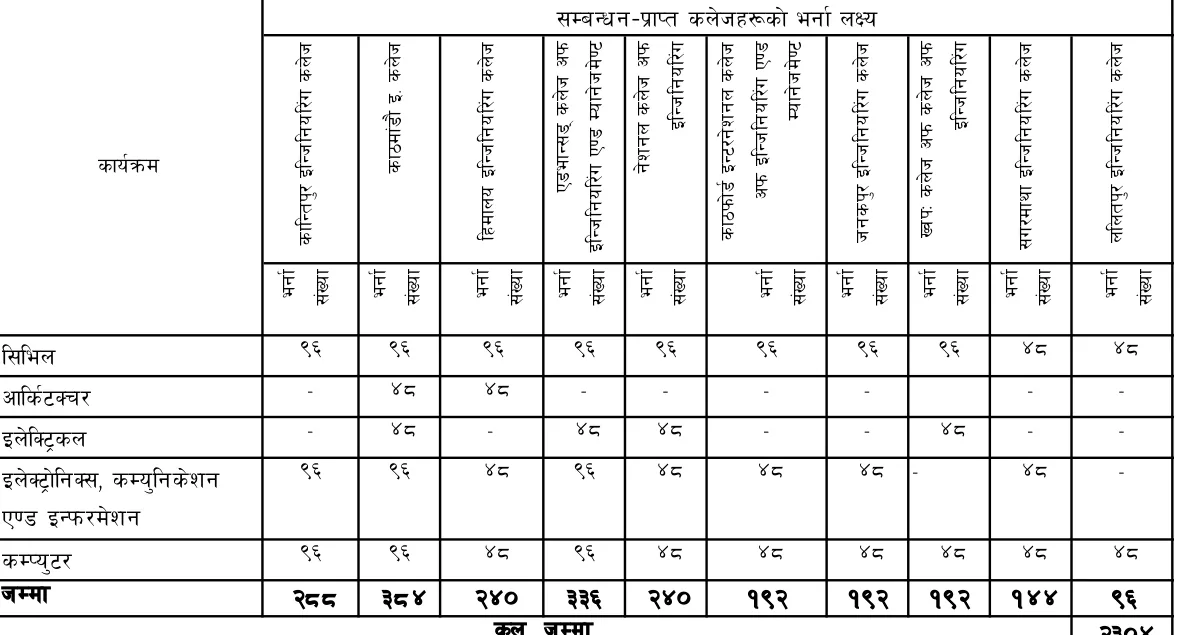
Confirm the specific programme you want appears against that college in the intake table on page 10. Affiliation is granted to a college, but a programme it does not run is not going to start because you enrolled.
Note the name IOE uses, not the name on the signboard. Records lag renames by years, and a search for the current name can return nothing while the college is plainly listed under the former one.
So stop asking whether the degree is the same
It is. Ask instead who teaches the subject you care about, how many sections run, whether the lab has enough stations for the class size, and what happens when a teacher leaves mid-semester. Those answers differ enormously between colleges and none of them appear in a prospectus.
The institute’s constitution and the five-institute structure are from section 1, page 6 of the IOE B.E./B.Arch Booklet 2083. The affiliated-college list is section 2.6, page 9, and the per-programme intake table is page 10. The three lists on IOE at a glance were read on ioe.tu.edu.np on 31 August 2026. Recognition by the Nepal Engineering Council follows the programme rather than the college.
Sources
- IOE B.E./B.Arch Booklet 2083published 7 August 2026 · read 31 August 2026
- IOE at a glance, Tribhuvan Universityread 31 August 2026
Last reviewed by Ram Raj Thapa, Admissions Officer, Imperial College of Engineering. Every figure on this page is cited to the document it came from.