
What is the IOE student code of conduct, and what are the penalties?

Seventeen rules, covering university rules and dues, honest disclosure, conduct inside and outside the campus, uniform and ID, and examination behaviour. Penalties run from a warning to expulsion from the university, and taking admission counts as accepting all of it.
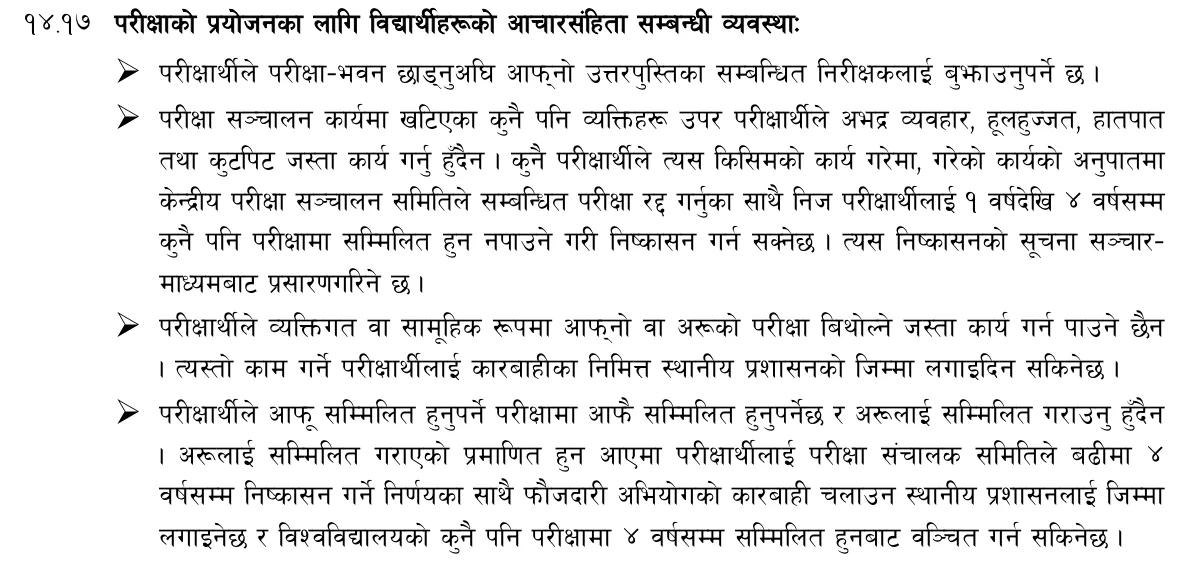
The booklet sets out a code of conduct in seventeen numbered rules and, separately, the eight sanctions available for breaching it. One clause at the end is worth reading first: admission to a campus or college is deemed to have been made on the basis that both sections are accepted. You are never asked to sign it, and accepting a seat accepts it anyway. Two rules surprise people. Discipline is required outside the university’s premises as well as inside them, and where an incident arises from a student’s disciplinary negligence the responsibility is the student’s own, with action possible under Nepal’s ordinary law. And falsifying your date of birth, address or academic record to obtain admission, a scholarship or a concession is itself a listed breach.
What does the code require of you?
- Comply with the acts, rules, procedures, directives, notices and circulars of the university, its campuses and its bodies.
- Take part in your academic programme, and remain studying and striving to pass it.
- Contribute to the standing and good name of the university, and behave well towards other students.
- Address and treat officials, teachers and staff respectfully.
- Give true particulars. Do not conceal or falsify your date of birth, place of birth, address or academic qualifications to obtain admission, a scholarship, a medal, a concession or any other right.
- Pay fees and any additional amounts within the stated deadline.
- Carry your identity card when entering or remaining on campus, and wear the prescribed dress where one is prescribed.
- Use and comply with the uniform your campus prescribes.
- Return library books and clear any outstanding dues by the stated deadline when your study or term ends.
What is prohibited on the premises
The booklet lists seven acts a student may not do or cause to be done inside university premises, and one of them catches ordinary student life rather than misconduct.
- Organising or running any public assembly, exhibition, sports event, music or dance, drama, film show, cultural or entertainment programme without the prior approval of the campus head or an authorised official.
- Being present with, or gathering with, any lethal weapon or prohibited article.
- Rowdiness, pressure, coercion, vandalism, obscene gestures, beating, assault, abusive language, indecent behaviour and gherao.
- Bringing unhealthiness or hostility into the academic environment.
- Littering and other polluting acts.
- Entering prohibited areas.
- Anything else the head of the campus, department or body has notified as prohibited.
Three more rules sit alongside those. A student may not attend classes or laboratory work at another campus without approval, may not damage or misuse university property, and may not enter or leave a class or laboratory without the teacher’s permission.
The penalty ladder
Warning.
Fine.
Written admonition.
Full or partial compensation for loss or damage.
Suspension from class or laboratory for up to 15 days.
Expulsion from the campus or department for a specified period.
A bar on admission to future academic programmes at that campus or department for a specified period.
Expulsion from studying at the university for a specified period.
Who decides, and which penalty is not theirs to give
One or more of these may be imposed depending on the nature, type and severity of the breach. The power rests with the head of the campus, department or body where the student is registered, with one exception.
The seventh sanction, the bar on admission to future programmes, is reserved to the university’s Executive Council, acting on that head’s recommendation. Everything else is decided locally.
Two rules that reach past the incident
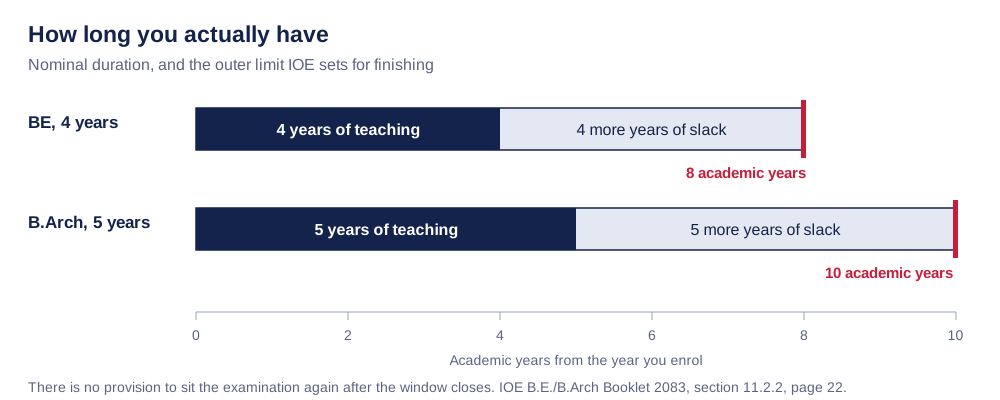
The bar on future admission and expulsion from the university are the ones that end a degree rather than interrupt it, because the eight-year completion window keeps running throughout and there is no re-examination provision once it closes.
A campus can also add to the code. The booklet allows a campus head, principal or departmental head to issue further conduct requirements by notice, and a breach of those attracts the same eight penalties from the same authorities.
Sections 14 and 15 of the booklet, pages 22 to 25, read off rendered page images. The booklet carries a standing note that its provisions may be changed by the competent authority, and that where a provision conflicts with the underlying Rules the Rules prevail, so check the current text with your campus before relying on any single clause.
Sources
- IOE B.E./B.Arch Booklet 2083published 7 August 2026 · read 18 August 2026
Last reviewed by Ram Raj Thapa, Admissions Officer, Imperial College of Engineering. Every figure on this page is cited to the document it came from.