
What are the penalties for cheating in an IOE examination?
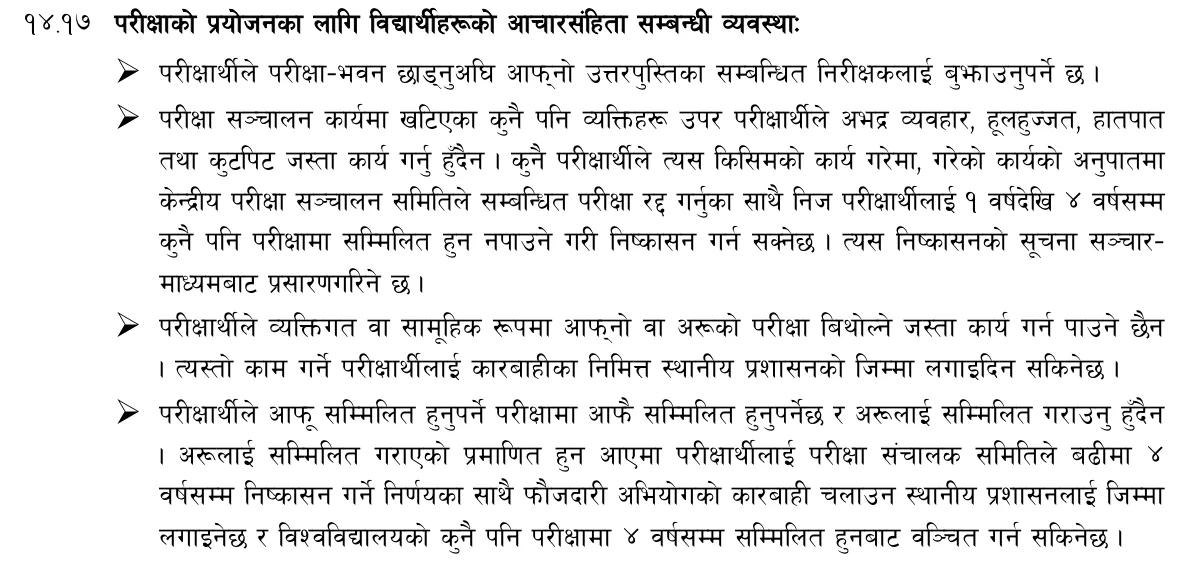
Cancellation of that examination plus expulsion from sitting any examination for one to four years, publicised through the media. Impersonation can also be referred for criminal prosecution.
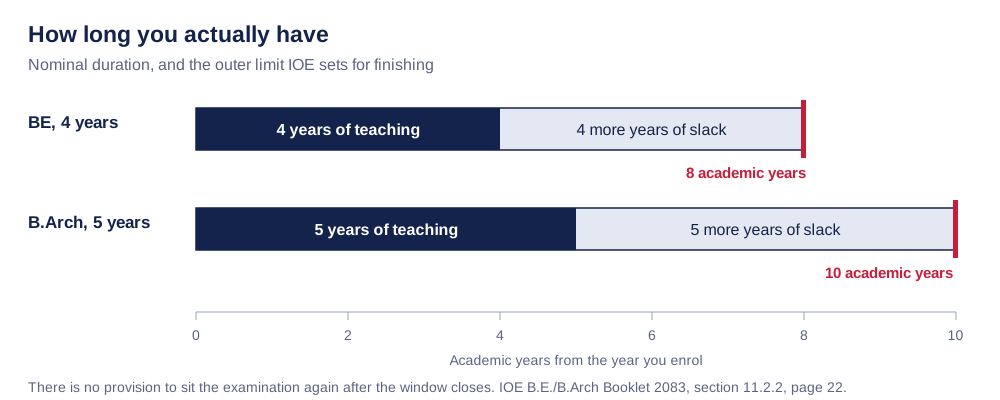
The published penalties are heavier than most candidates assume, and they reach well beyond the paper you are sitting. The booklet gives the central examination conduct committee power to cancel the examination concerned and, in proportion to the act, to expel a candidate from sitting any examination for one to four years, with the notice of that expulsion broadcast through the communication media. For impersonation the committee may expel for up to four years, hand the matter to the local administration to pursue criminal proceedings, and bar the candidate from any university examination for up to four years. Read those terms against the rule that a four-year programme must be completed within eight academic years with no re-examination provision afterwards, and a multi-year ban is degree-ending rather than merely serious.
Misconduct towards examination staff
Indecent behaviour, rowdiness, physical violence or beating towards anyone deployed on examination-conduct duty is prohibited. Where it occurs, the central examination conduct committee may cancel that examination and, in proportion to the act, expel the candidate from sitting any examination for one to four years.
The publicity is part of the penalty rather than a side effect. The booklet states that the notice of expulsion is broadcast through the communication media.
Disrupting an examination
A candidate may not do anything of the nature of disrupting an examination, their own or someone else’s, individually or collectively. A candidate who does may be handed over to the local administration for action.
Note the wording, because it is wider than a rule about copying. It covers disruption of your own examination as well as of other people’s, which puts protest, obstruction and walkouts inside the same clause.
Impersonation, which carries the heaviest terms
A candidate must sit their own examination and must not have another person sit it for them. Where that is established, the examination conduct committee may expel the candidate for up to four years, refer the matter to the local administration for criminal prosecution, and bar the candidate from any university examination for up to four years.
Those three are cumulative rather than alternatives, and the criminal referral is the only place in the booklet where a student rule reaches outside the university at all.
The procedural rule that is easy to breach by accident
Hand your answer sheet to the invigilator before leaving the examination hall. Walking out with it is a breach in its own right, listed first among the four rules in this section.
Section 14.17 of the booklet, page 24, read off a rendered page image. Penalties are set by the central examination conduct committee and are discretionary within the stated ranges. An earlier version of this answer described the third rule as a prohibition on copying; the clause is about disrupting an examination, and section 14.17 contains no copying rule.
At Imperial College of Engineering
Nothing on this page is our rule to make or to soften. It is IOE’s, it applies to every candidate at every campus and college in the system, and the sanctions are imposed by IOE’s committee rather than by a college.
Sources
- IOE B.E./B.Arch Booklet 2083published 7 August 2026 · read 18 August 2026
Last reviewed by Ram Raj Thapa, Admissions Officer, Imperial College of Engineering. Every figure on this page is cited to the document it came from.