
What happens if two candidates get the same IOE entrance score?

A three-level tie-break: total marks to three decimal places, then Mathematics, Physics, Chemistry and English in that order, then +2 marks followed by SEE marks.
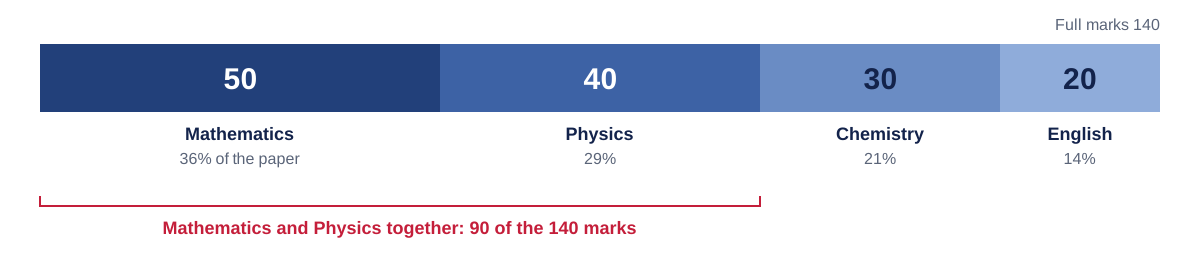
IOE breaks a tie with a published three-level ladder, applied in a fixed order. Your Entrance Score is the total marks expressed as a percentage, and when two or more candidates hold the same one, the first step is to recompute the total marks to three decimal places and place the higher candidate first. If they are still equal, subject marks are compared in the order Mathematics, Physics, Chemistry, English, and whoever is higher in the first subject that differs is placed ahead. If that also fails, 10+2 or equivalent marks are compared, and after that SLC/SEE marks. The ordering is not arbitrary: it follows the mark weighting, so Mathematics at 50 marks is both the largest block on the paper and the first subject to settle a tie. On a merit list of more than seven thousand names, exact ties happen, and the ladder is how they are settled.
Total marks are calculated to three decimal places. Whoever is higher is placed first.
If still equal, subject marks are compared in a fixed order: Mathematics, then Physics, then Chemistry, then English. Whoever is higher in the first subject that differs is placed first.
If still equal, the 10+2 or equivalent marks are compared, and after that the SLC/SEE marks. Whoever is higher goes ahead.
Why does the ladder start with three decimal places?
The Entrance Score set against your name is the total marks expressed as a percentage. When two of those match, the ladder goes back to the total and carries it to three decimal places, which separates candidates whose scores agree at the precision the list shows but not underneath it. Only when that also comes out equal does the ladder move to subjects.
Which subject decides a tie first?
Mathematics, then Physics, then Chemistry, then English. That is the same order as the mark weighting, where Mathematics carries 50 marks, Physics 40, Chemistry 30 and English 20, so the two rules point the same way. If two candidates are level, the one who was stronger in Mathematics takes the higher place, and English is only reached when the first three subjects have all come out identical.
The practical reading is that time given to Mathematics is worth slightly more than its 50 marks suggest, because those marks also carry the first casting vote in a tie.
Where do +2 and SEE marks enter?
At the bottom, and only there. The entrance carries 100% of the merit weight, so +2 marks contribute nothing to your score. They become the third tie-breaker, followed by SLC/SEE marks, and both are reached only after every figure the entrance itself produced has failed to separate two candidates.
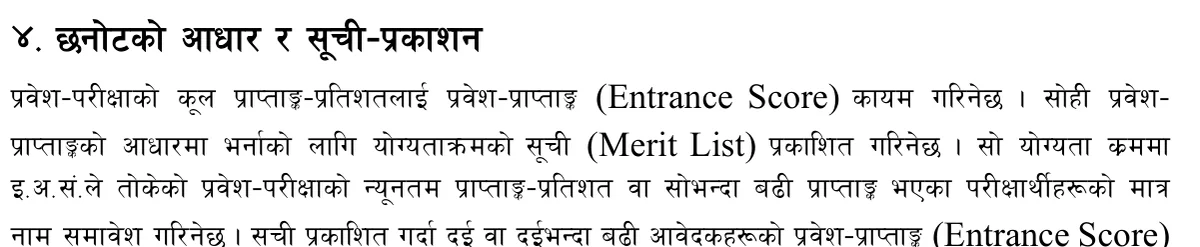
Section 4 of the booklet, printed page 12, read off a rendered page image. The merit list includes only candidates at or above the minimum percentage IOE sets for that year. This answer carries no figure: the ladder is already set out as steps above, and the section-4 page region is used on the pass-marks answer, where the same paragraph carries a different rule. The same PDF was re-downloaded and re-checked on 31 August 2026 and is unchanged.
Sources
- IOE B.E./B.Arch Booklet 2083published 7 August 2026 · read 18 August 2026
Last reviewed by Ram Raj Thapa, Admissions Officer, Imperial College of Engineering. Every figure on this page is cited to the document it came from.