
How are the 140 IOE entrance marks split between subjects?
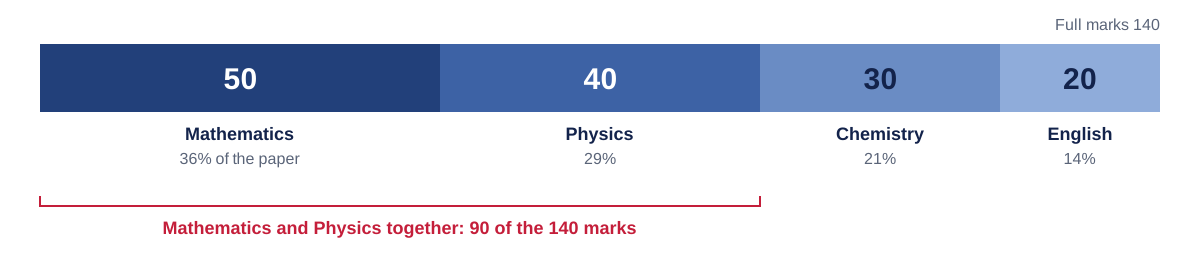
Mathematics 50, Physics 40, Chemistry 30 and English 20. Mathematics and Physics together are 90 of the 140 marks.
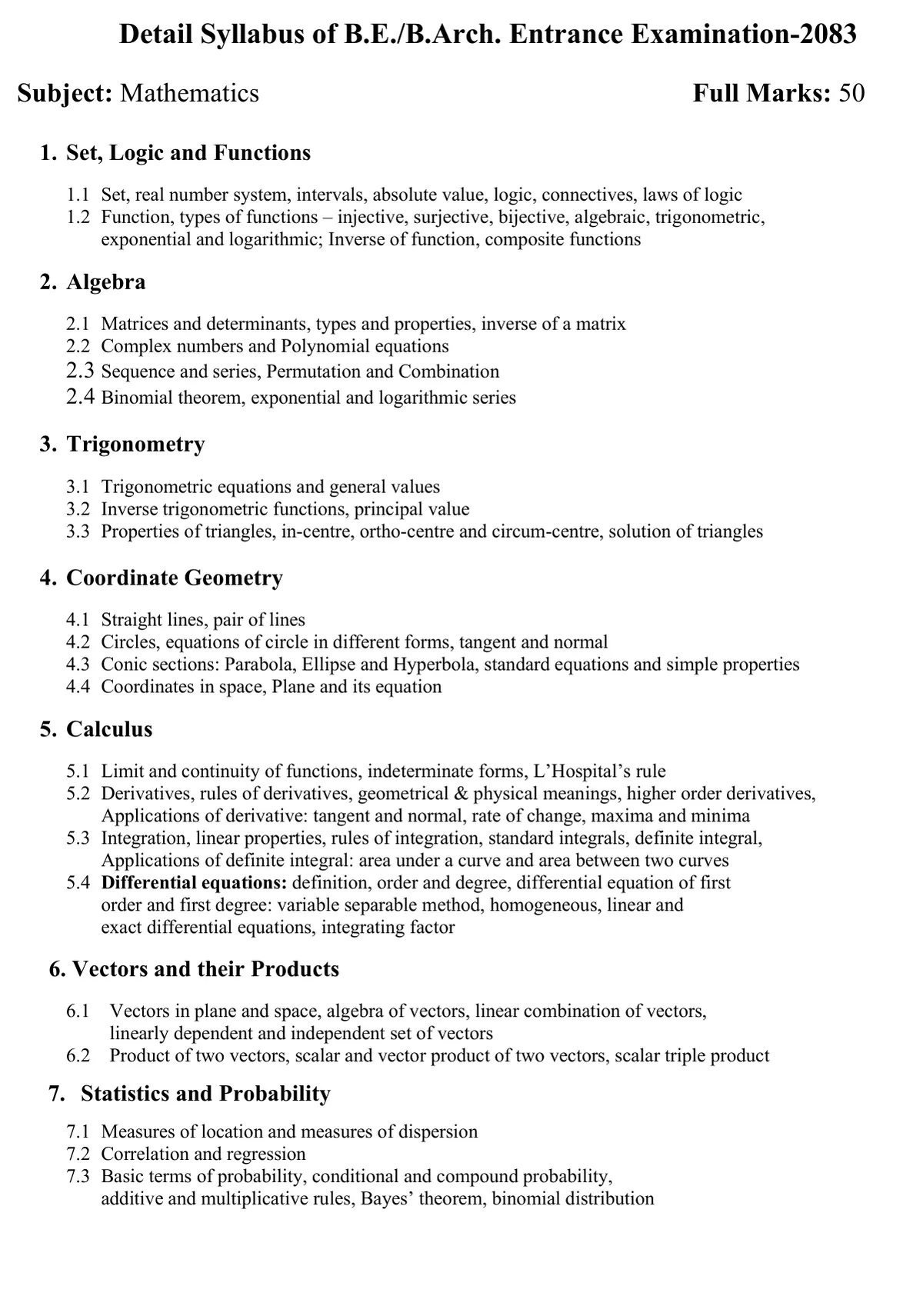
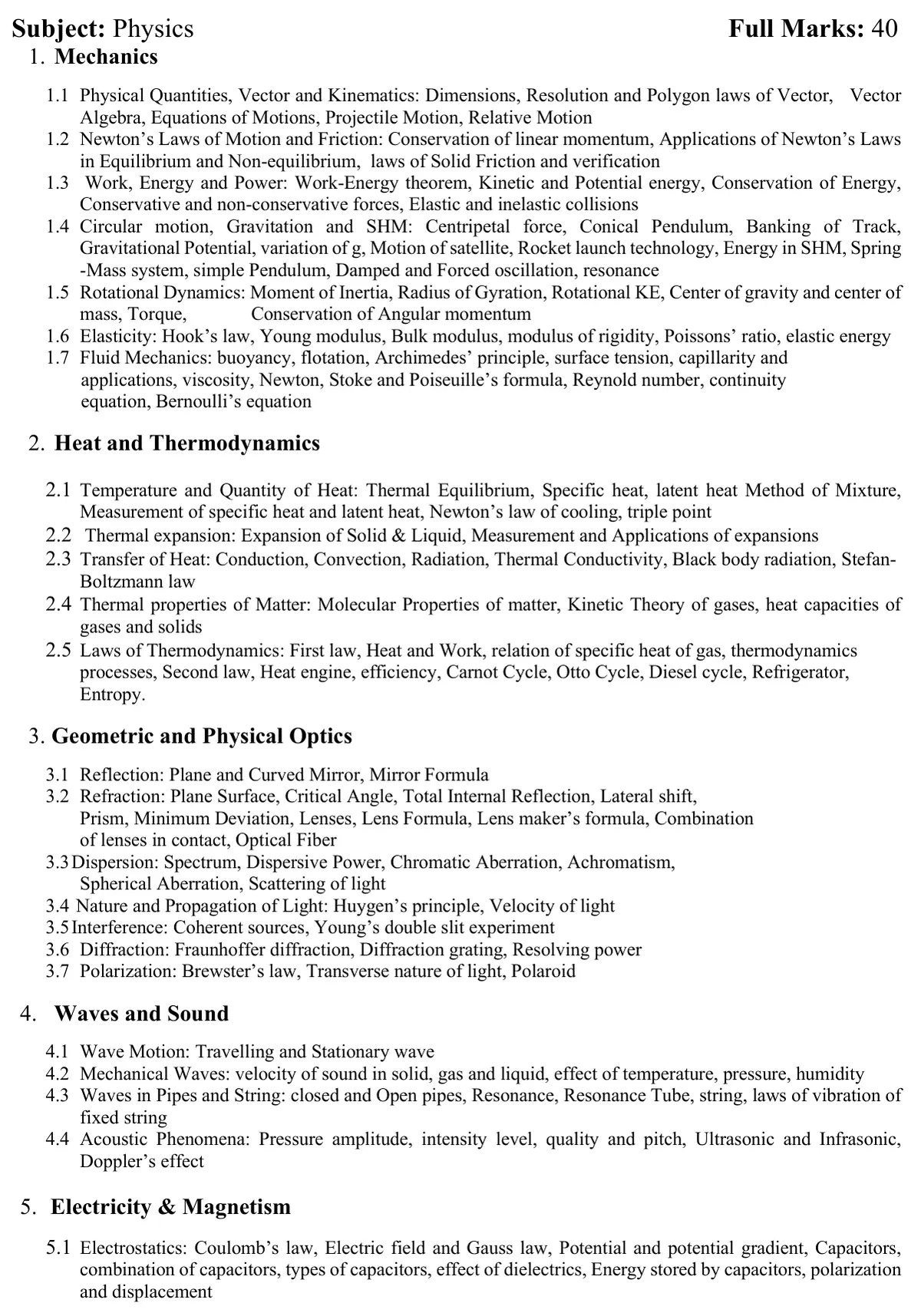
The 140 marks of the IOE entrance are split Mathematics 50, Physics 40, Chemistry 30 and English 20. Mathematics is 36% of the paper on its own, and Mathematics and Physics together carry 90 of the 140 marks, or 64% of everything on offer. The four figures are printed as the Full Marks line under each subject heading of the official syllabus, and they sum to 140, which reconciles with the question structure stated on page 3 of the same booklet. The split is not the same as the number of questions: Section A carries 60 one-mark questions and Section B 40 two-mark questions, and both sections draw on all four subjects. What the split does decide is where revision time is worth spending. A plan that gives four subjects equal hours is already misallocated, because English at 20 marks is a seventh of the paper and Mathematics is more than a third.
| Subject | Full marks | Share of the paper |
|---|---|---|
| Mathematics | 50 | 36% |
| Physics | 40 | 29% |
| Chemistry | 30 | 21% |
| English | 20 | 14% |
Scroll the table sideways for Share of the paper.
Why do Mathematics and Physics decide the paper?
Together they are 90 of the 140 marks, or 64% of the paper. What that changes is where the headroom sits. Ten marks gained in English is half of everything that subject offers and there is no eleventh; ten marks gained in Mathematics is a fifth of that subject, with 40 still on the table.
The practical reading is that Chemistry and English are worth securing rather than maximising. Both are bounded, and the marks that separate candidates near the top of the merit list are in the two large subjects.
Does the tie-break follow the same order?
It does, and that is worth knowing. Section 4 of the booklet breaks a tie by comparing subject marks in the order Mathematics, Physics, Chemistry, then English. That is the same order as the mark weighting, so the subject carrying the most marks is also the one that settles a tie first. Where two candidates finish level, the one who was stronger in Mathematics is placed ahead.
Is English worth revising at 20 marks?
At 20 marks it is the smallest block, and the phonetics topics are the most neglected part of it: which syllable carries the stress, which pairs share an initial vowel sound. Those are learnable in an afternoon and they appear in the booklet’s own model questions, where two of the three English samples in Section A are phonetics items.
Comprehension explicitly names Technical English alongside General English, so reading practice on technical prose is on syllabus rather than optional. English is also where the 10% deduction applies to the largest number of individually cheap decisions, because a guessed preposition costs 0.1 of a mark and there are many of them.
Marks read from the subject headers of the Detail Syllabus of B.E./B.Arch. Entrance Examination-2083 inside the booklet, printed pages 26 to 29. Those pages are set in Latin type and extract reliably. The four figures sum to 140, which reconciles with the question structure on printed page 3. The same PDF was re-downloaded and re-checked on 31 August 2026 and is unchanged.
Sources
- IOE B.E./B.Arch Booklet 2083published 7 August 2026 · read 18 August 2026
Last reviewed by Ram Raj Thapa, Admissions Officer, Imperial College of Engineering. Every figure on this page is cited to the document it came from.