
Can an engineering programme be cancelled for the year if too few students enrol?

At an IOE constituent campus, yes. If the Full Fee and sponsored quota of a programme is not filled to 60% within the first three merit lists, the campus may suspend that programme for the year, and admission fees must then be refunded in full.
Yes. At an IOE constituent campus an engineering programme can be cancelled for the year if too few students enrol, and the provision that allows it is published but almost unknown. If within the first-phase admission programme, meaning the first, second and third merit lists, the full-fee and sponsored quota of any programme is not filled to sixty per cent, the campus may suspend that programme for that year. Where that happens the booklet requires admission fees to be refunded in full, which is a far better term than the ordinary cancellation ladder gives anyone. Two details decide who this actually affects. The sixty per cent test is measured on the full-fee and sponsored quota rather than on the Regular seats, so a programme can be comfortably full on the subsidised side and still fail it. And it is a power rather than a duty: the booklet says the campus may suspend, so the decision rests with the campus.
What is the "sponsored quota" in that test?
It is the seats reserved under section 6.4 for candidates whom a government office or government-owned institution pays to send. Those seats sit on the full-fee side and are counted with it for this test, which is why the threshold is written as the full-fee and sponsored quota rather than as the full-fee quota alone.
What it means practically
- A small intake is not only a quiet classroom. At a constituent campus it can mean the programme does not run at all that year.
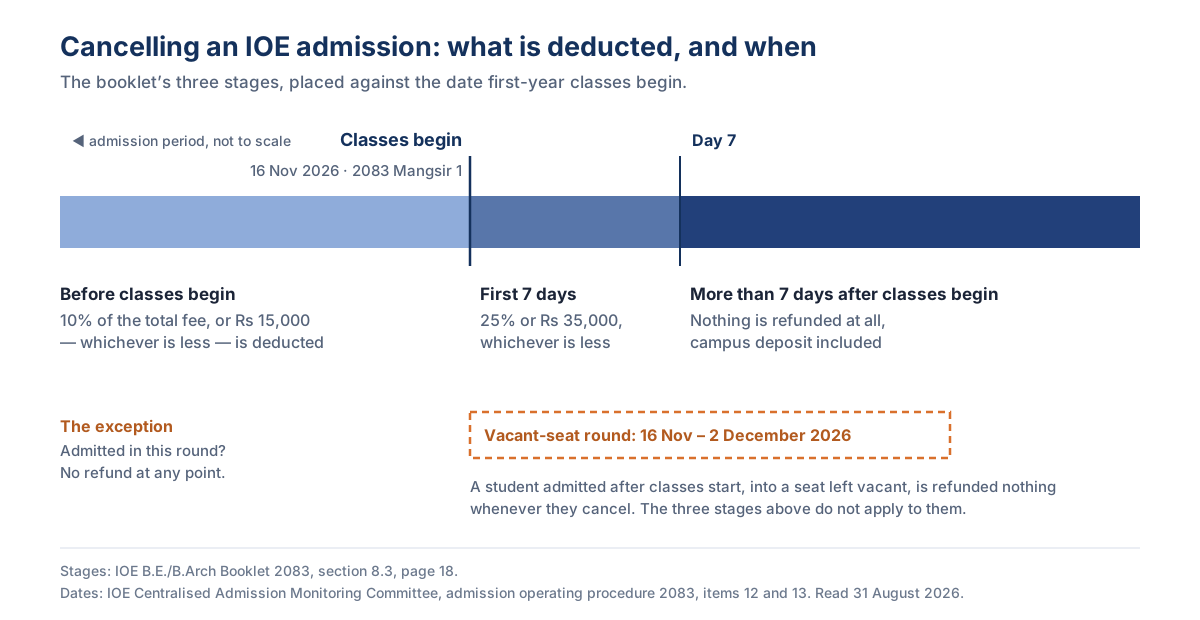
- Your admission fee comes back in full in that case, deposits and all, which the ordinary cancellation ladder never gives you.
- The 60% test is measured on the full-fee and sponsored quota, not on the Regular seats, so the subsidised cohort being full does not save the programme.
- It is decided within the first three lists, so you will usually know before classes begin rather than after.
Why the test sits on the full-fee side at all
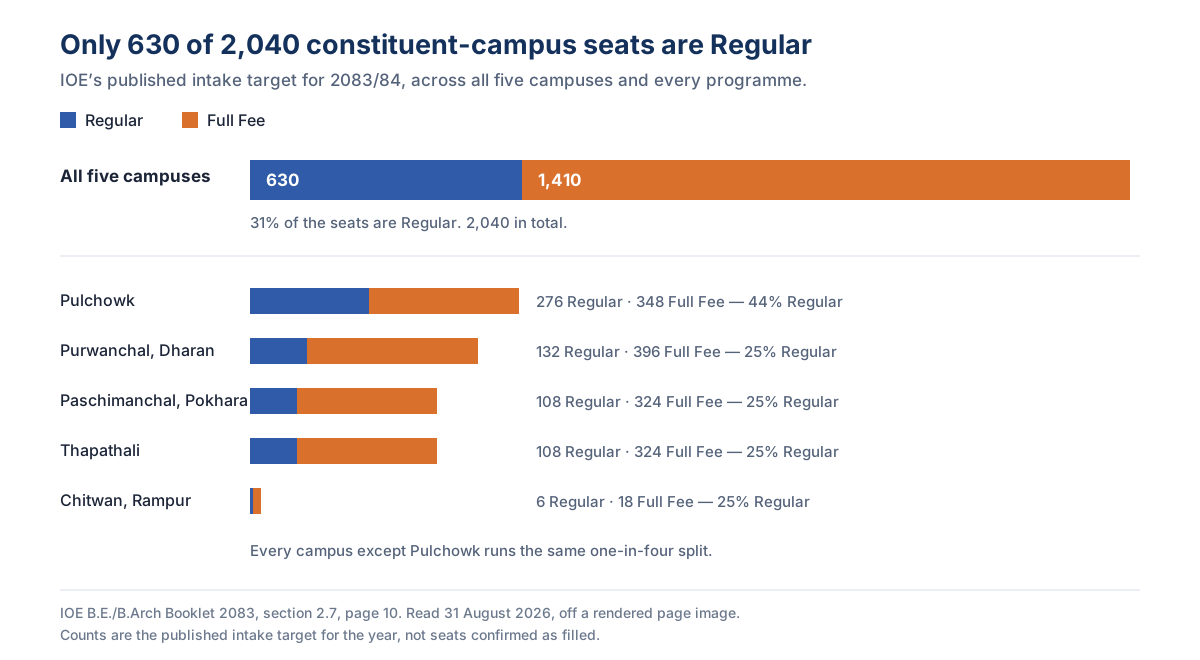
The clause immediately before it explains the arithmetic. A constituent campus admits under two tuition rates: students taken as Regular pay the minimum tuition fee, and the remaining applicants may be admitted paying the full-fee rate. The Regular cohort is therefore the subsidised one and the full-fee cohort is what pays for the programme to run. Measuring the sixty per cent on the full-fee and sponsored quota is not an arbitrary choice of denominator; it is the campus asking whether the paying half of the intake has materialised. A programme with every Regular seat taken and a thin full-fee cohort is exactly the case the clause was written for.
What a suspension leaves you with, in time
More room than it sounds, if you move. The decision has to be taken inside the first-phase admission programme, which in the 2083 cycle ended when third-list admission closed on 8 September 2026, and first-year classes did not begin until 16 November. A candidate refunded in September was therefore refunded while other campuses were still running fourth and later lists, and while the vacant-seat route stayed open to 2 December. The full refund is worth little if you discover it in December, so the practical instruction is to ask the campus directly once the third list has closed rather than waiting to be told.
Does it apply to TU-affiliated private colleges?
No, and the booklet is unusually clear about that by omission. Section 8.6 names exactly which parts of the document bind affiliated colleges as well as constituent campuses: sections 7.1, 7.4 and the whole of section 8, which is the documents list, the dual-registration rule and the cancellation and refund clauses. The suspension provision is section 2.7 and it is not on that list. So if you are enrolling at a private college and the cohort looks thin, there is no published full-refund right to fall back on. Ask what happens if the programme does not run, ask for the answer in writing, and ask before you pay.
Section 2.7(b) of the BE/B.Arch Booklet 2083, page 11, read off a rendered page image. Section 8.6, page 19, is what limits it to constituent campuses by naming the clauses that do extend to affiliated colleges. This is a "may", not a "must": the decision rests with the campus.
Sources
- IOE B.E./B.Arch Booklet 2083published 7 August 2026 · read 18 August 2026
Last reviewed by Ram Raj Thapa, Admissions Officer, Imperial College of Engineering. Every figure on this page is cited to the document it came from.